This month we’re introducing several new features to Microsoft Stream that will help you do more with video at work or on the go. These enhancements to video curation, playback and our mobile app make Stream (on SharePoint) a more robust platform for your videos needs. Let’s take a look at the new video organization, playback and viewing options across Microsoft 365.
Playlists
Stream recently launched Playlists, a new feature that allows you to curate video or audio collections within Microsoft 365. Playlists combines the ease of use of Microsoft Lists with the value of video. With playlists you can create and share an organized collection of related content such as training videos, product demos, or Teams meeting recordings. It’s simple to share playlists, but note that users who want to watch videos in the playlist need to have view access to those videos. Once your create a playlist or one is shared with you, it will appear on your Stream start page and your Lists home page. Learn more.
Playlists makes it easy to view and share a collection of audio and video files.
Offline viewing on the Stream mobile app
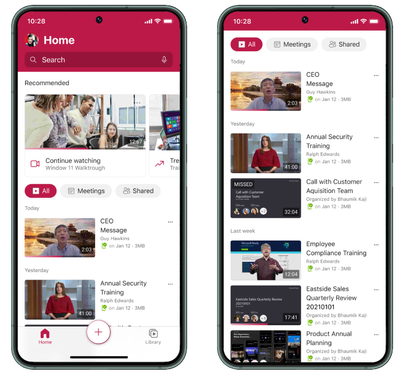
The Stream mobile app for iOS and Android now lets you download your Stream (on SharePoint) videos while you're connected to the internet so that you can watch them later without an internet connection. This feature is particularly useful if you travel frequently, have limited access to the internet, or have data limits on your mobile device. It also lets you watch videos without any buffering for a smooth and uninterrupted playback experience.
The Stream app on iOS and Android now offers video download for offline viewing.
Variable speed playback
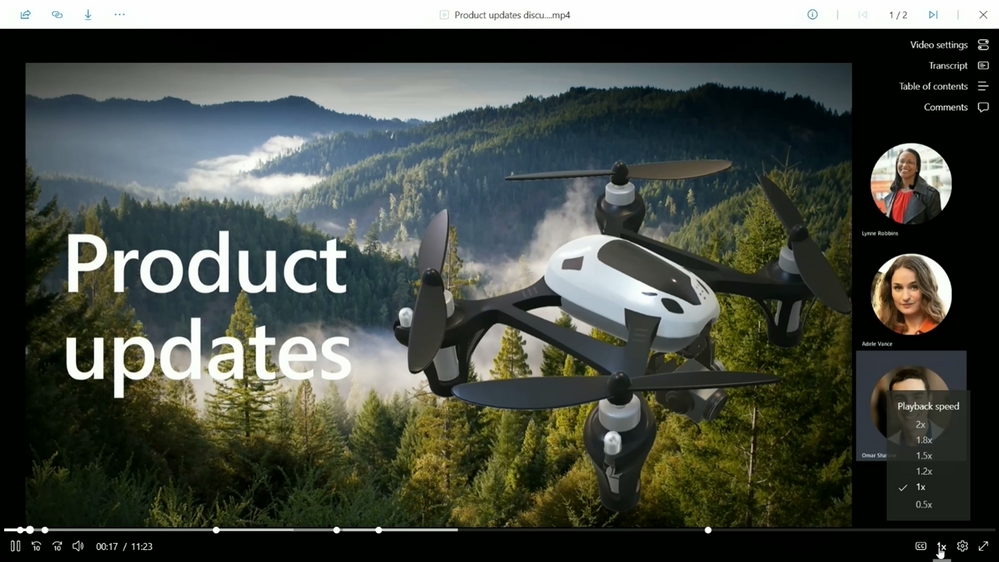
Now when you play a video in Microsoft 365, you’ll have the option to control the playback speed. Instead of playing the video at the standard speed, you can choose to play it at a slower or faster speed (between 0.5x and 2x). Play it fast when you want to quickly review content and slow it down to improve comprehension on complex topics. Variable speed playback enhances the video viewing experience and makes videos more accessible for a wider audience.
Variable speed playback allows you to choose the speed at which your video plays in Stream.
Analytics and search in the Stream web app
When you open a video from within Microsoft 365 you’re taken to the Stream web app to view the video. The web app player gives you enhanced playback that includes transcripts, captions, chapters, sharing, background noise suppression, and as mentioned above variable speed playback. We’re now adding two new features to the Steam web app player.
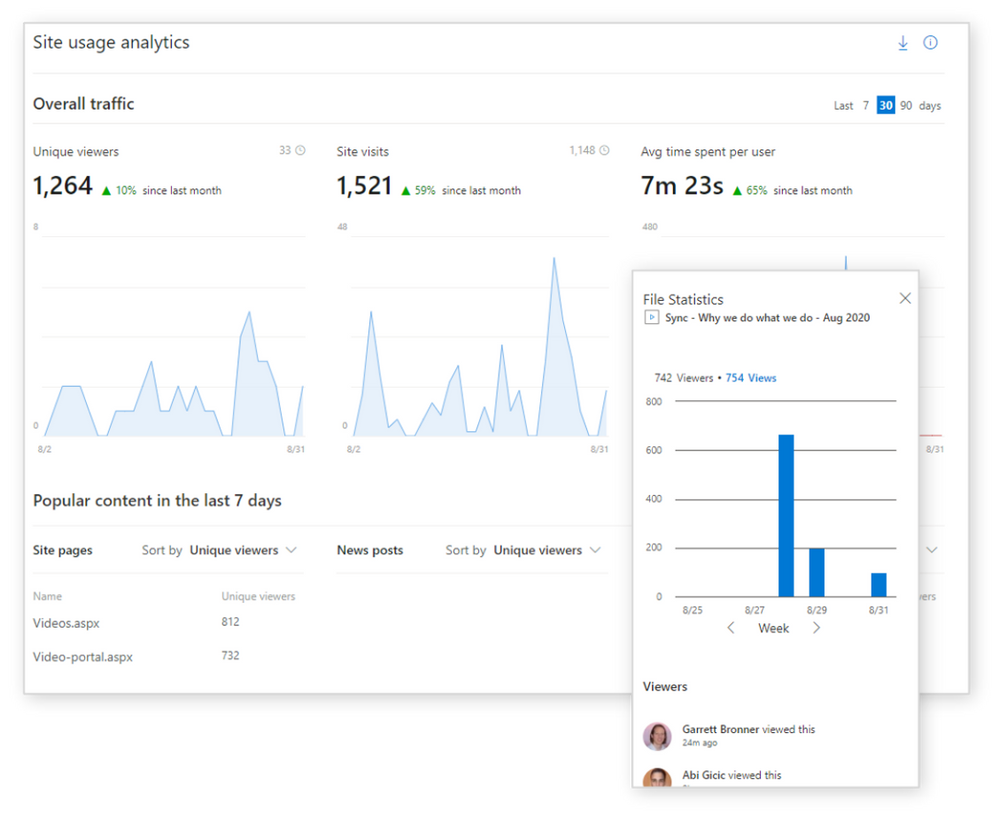
Analytics: Now, you can view analytics for any video that you have view permissions. When you tap the “Analytics” icon on the right side of the screen, you’ll see total number of views and viewers for the video. Additionally, you’ll see an overlay on the video that shows viewer retention to help you understand which parts of your video are working and where viewers are dropping off.
Stream’s analytics pane shows video views and viewers over time.
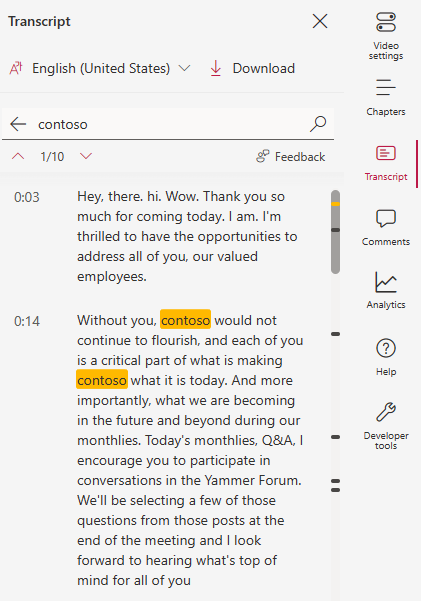
Transcript Search: Now you can search transcripts to find information quickly in a meeting recording or video. Just enter keywords in transcript search box, then navigate through the results. Clicking on any result will play that section of the video.
Find what you need quickly with keyword search within video transcripts in Stream.
Embed codes
With Stream (on SharePoint) you’ve long been able to embed videos into SharePoint sites and pages. Now you can use Stream embed codes to embed videos in other internal websites. Internal sites, such as those for training, feedback, or expenses can now all be easily enriched with video content. Learn more.
Stream (on SharePoint) is available to GCC and DoD customers
Stream on SharePoint is now available to GCC (Government Community Cloud), GCC-High and DOD (Department of Defense) customers. If you’re a government user, you can now leverage many of the new Stream (on SharePoint) video capabilities within your Microsoft 365 environment. All the features that we noted in the blog Stream on SharePoint now generally available are now available to GCC and DOD customers with the exception of a) migration tool and b) the Stream mobile app which is available to GCC-moderate and coming to GCC-High and DOD later this year.
We welcome your feedback. Feel free to comment below or share and vote on ideas in the Stream feedback portal
As we shared in November 2021, Stream (Classic) will be retired as customers transition to the new Stream platform built on SharePoint. Today, we are sharing the update that Microsoft will retire Stream (Classic) on February 15, 2024 for all customers except GCC, and we will turn off upload functionality in August 2023.1 The successor service, Stream (on SharePoint), entered general availability in October 2022, and has been widely popular since we first announced it more than two years ago. In 2022, billions of videos were uploaded to the service, and its use continues to grow rapidly because of how simple it is to create, discover, and view video across Microsoft 365.
Stream (on SharePoint) puts video in the flow of work
Stream (on SharePoint) brings you many of the same capabilities of Stream (Classic) while also allowing you to use video in many everyday work and school apps such as Teams, Office.com, Yammer, Viva, PowerPoint, and SharePoint. With video now in the flow of your work, you can more easily create and discover video content for collaboration and knowledge transfer. Here’s a quick look at the capabilities of Stream (on SharePoint) that are not available in Stream (Classic):
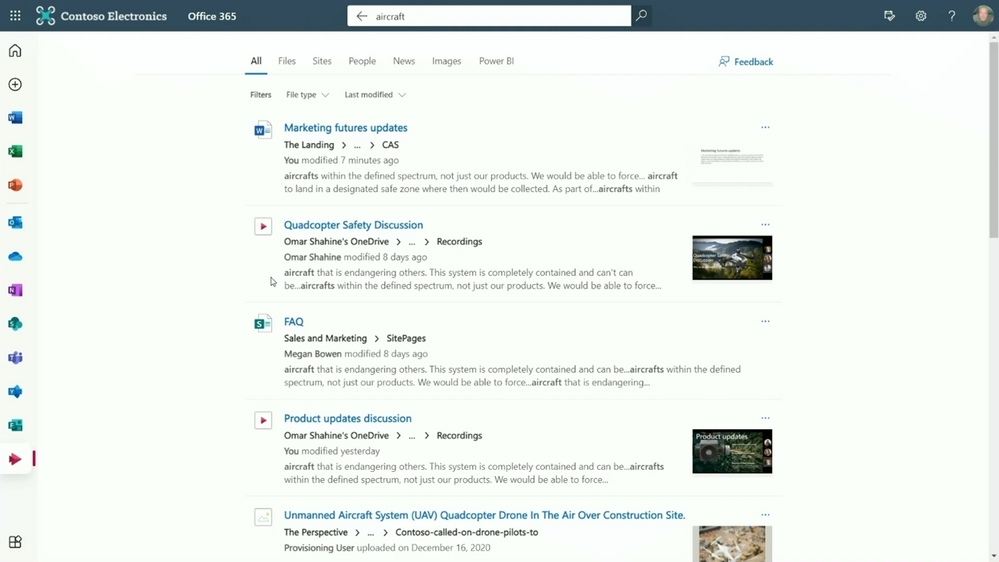
Search for videos anywhere in Microsoft 365. You can now find videos and Teams meeting recordings across Microsoft 365 by searching keywords such as those found in the title, description, chapter names, or transcripts of videos.
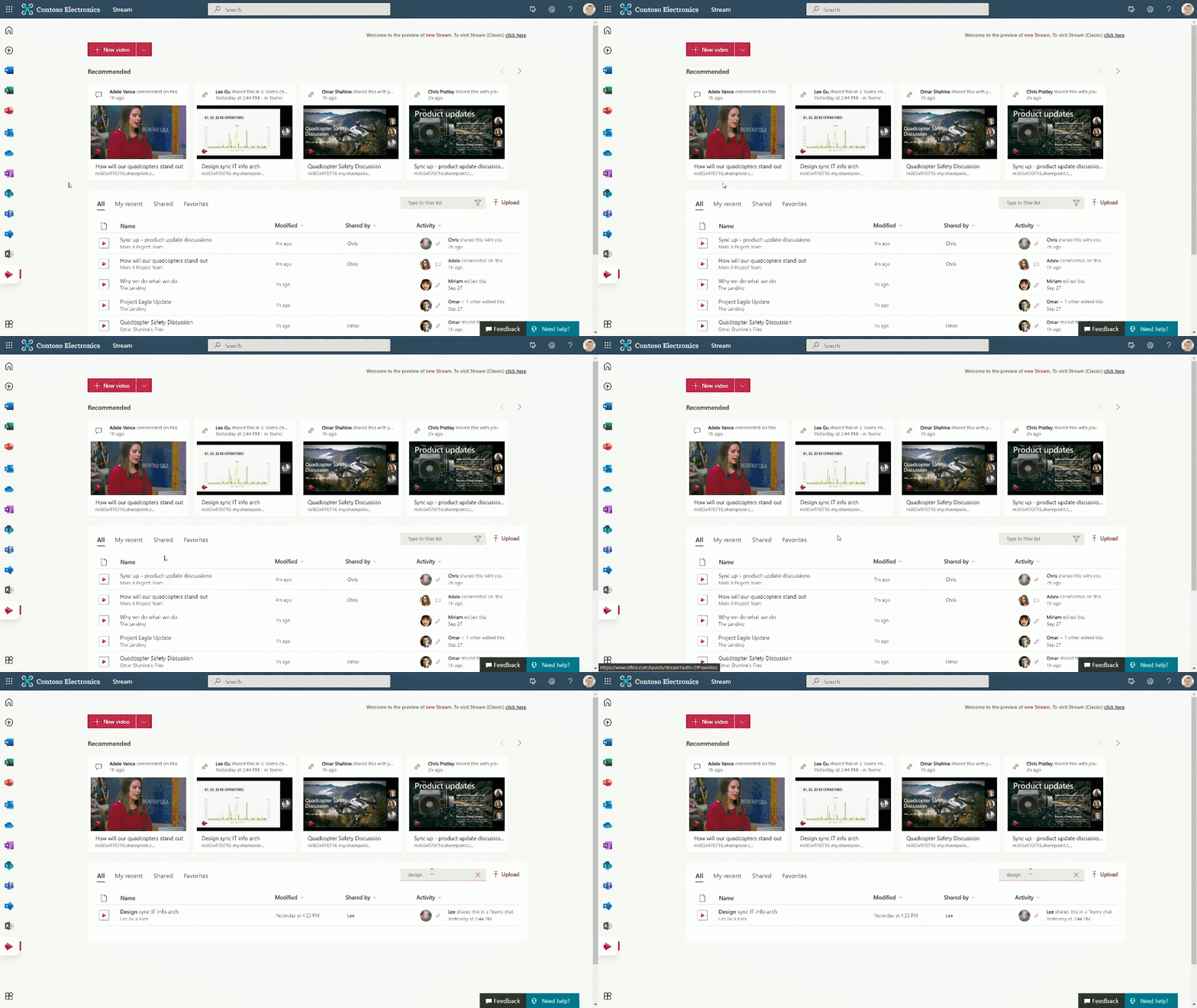
Find what you need quickly on the Stream start page in Office. The new start page shows recent, shared, and favorite videos, with playlists coming soon. (Note: The Stream start page doesn't show you videos in Stream (Classic); it only shows videos directly stored in Microsoft 365.)
View Teams meeting recordings with transcripts, chapters, timeline markers, speaker attribution, and comments.
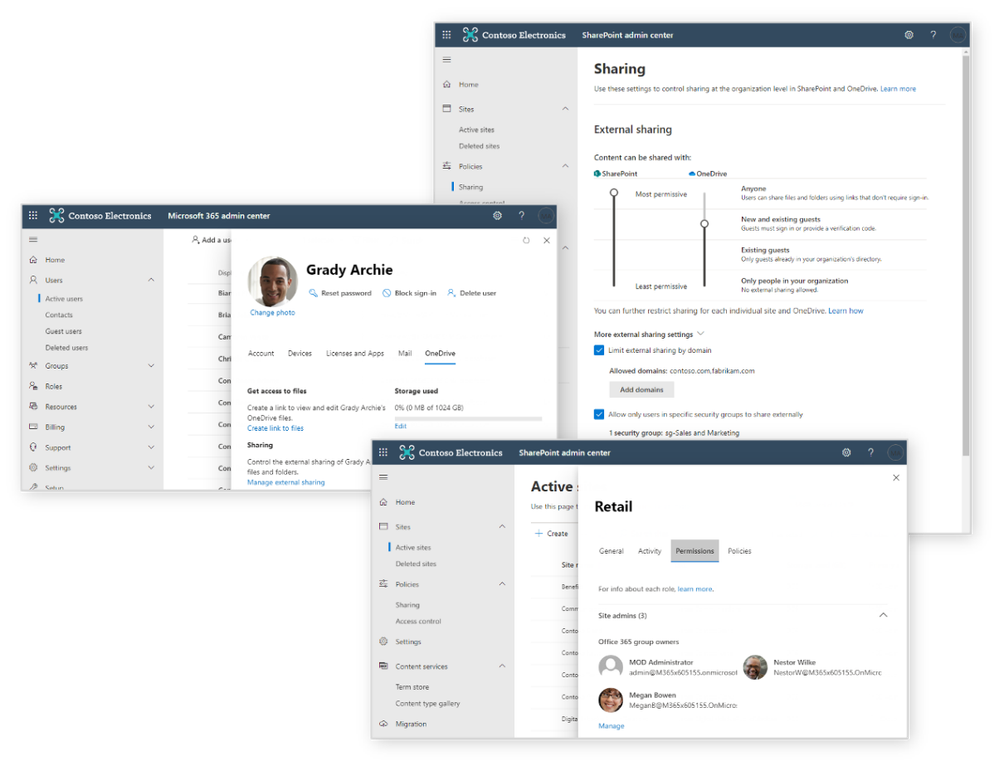
Easily manage video files with the same security, admin controls, multi-geo support, compliance (eDiscovery, legal hold, retention, and data loss prevention policies), permissions, and sharing controls as the rest of your files in SharePoint and OneDrive.
These benefits add up to ease of video management for admins and more productivity for your teams. Stream (on SharePoint) helps you communicate visually to explain, learn, and collaborate across teams.
Stream (Classic) retirement timeline While Stream (Classic) will be available until February 15, 2024, we plan to retire some functionality sooner than 2024. For example, we will disable the uploading of videos to Stream (Classic) on August 15, 2023. See the Stream (Classic) retirement timeline for the most current dates in the retirement process.
The timeline for Stream (Classic) retirement is as follows:
February 15, 2023 - Start of one-year countdown to retirement, and Stream (Classic) migration tool enters general availability with these enhancements: -Single video embed codes redirect and play inline. -New settings added to schedule/delay blocking of uploads and tenant disablement.
May 15, 2023 - No new videos can be uploaded to Stream (Classic). Admins can delay this by three months if needed.2 August 15, 2023 - No new videos can be uploaded to Stream (Classic). October 15, 2023 - Users can no longer access or use Stream (Classic). Admins can delay this change by four months if needed.2 February 15, 2024 - Stream (Classic) is fully retired and automatically disabled. -Users and admins can no longer access or use Stream (Classic). -Any remaining content in Stream (Classic) that wasn't migrated will begin being deleted.
February 15, 2025 - Stream (Classic) links and embed codes will no longer redirect to the migrated videos in OneDrive and SharePoint.
If you are a Stream admin, we recommend that you begin planning your organization’s migration to Stream (on SharePoint) and onboarding your users to this service as soon as possible.
Migrating your content from Stream (Classic) to Stream (on SharePoint) To support your move to Stream (on SharePoint), we have created a migration tool that allows you to transfer all your Stream (Classic) video to Stream (on SharePoint). The tool also brings over metadata, links, and permissions associated with your Stream (Classic) audio and video content. The migration tool is now in public preview, and we expect it to become generally available on February 15, 2023 for all Stream customers, except GCC.
Stream live events retirement We have not yet announced a retirement date for Stream live events. In the coming months, we will announce the retirement date of Stream live events and give you a six-month period to begin using the successor service, Teams live events with external encoder support, which is currently in public preview.
Feedback & learn more
We welcome your feedback. Feel free to comment below or share and vote on ideas in the Stream feedback portal.
Lastly, we’d like to invite you to join our customer connections office hours. In this twice-monthly meeting, we answer your questions, share our plans, learn more about your video needs, and get your feedback. To get on the meeting invite list, you can sign up at aka.ms/StreamConnect.
1 The Stream (Classic) retirement date for Government Commercial Cloud (GCC) customers has not yet been announced. Until those dates are announced, GCC customers can continue to use Stream (Classic) without interruption. GCC customers will receive one-year advance notice of retirement.
2 Admin delay settings will become available in the Stream (Classic) admin center on Feb 15, 2023.
By Owen Paulus, Partner Group Product Manager, Office Media Group
Today, we are excited to announce that Microsoft Stream (on SharePoint) has reached its general availability milestone and is now ready to use. Stream (on SharePoint) will soon be replacing Stream (Classic)1. Unlike Stream (Classic), which functioned as a standalone portal and single point of video discovery, Stream (on SharePoint) is deeply integrated with Microsoft 365. Now, video can be a part of your everyday work and school apps: you can search, discover, play, share, embed, and record videos directly in Microsoft Office. If you are using Stream (Classic), it’s time to start moving to Stream (on SharePoint) to put video in the flow of your everyday work. In fact, Stream (on SharePoint) is already serving more video with more reliability to our customers than Stream (Classic).
For more information on how this new approach to enterprise video benefits your organization in terms of management, governance, customization, and life cycle, see the Stream IT guide. This is an exciting step in our journey to make video as simple to create, use, and manage as your documents, and we’re thrilled to share what’s new and what’s coming soon in this blog. We're also including demo videos to help you visualize the new Stream features (these videos have no audio).
New with playback, transcripts, and recording
Let’s look at what you can do with the new innovations in Stream (on SharePoint).
Playback: You can now watch videos in your favorite work apps, including Microsoft Teams, Yammer, Microsoft Viva, SharePoint, and office.com. When you open a video, it will play in the Stream web app, which gives you enhanced playback that includes transcripts, captions, chapters, sharing, background noise suppression, and, coming soon, variable speed playback. Plus, you can add comments with @mentions similar to Word, Excel, and PowerPoint. The Stream web app also allows you to upload, download, share, get embed codes, move, or copy videos. Soon, you’ll be able to record from the web app too. Learn more.
Transcripts: We’ve improved captions and transcripts to make them more accessible and boost your team’s productivity. Stream (on SharePoint) can now transcribe videos spoken in 28 different languages and locales, and transcripts now scroll automatically alongside the video. If you want to further polish the transcript as the video owner, it’s a snap to edit directly in the transcript pane to correct any mistakes. You can also manually add additional language versions of the transcript, which are shown in the transcript pane or as subtitles for viewers to follow along in other languages. Learn more.
Recording: By the end of 2022, you’ll be able to record yourself, your screen, or both at the same time from the Stream start page on office.com or from the Stream web app. Creating explainer videos, product demos, or updates for your team is simple, and you can personalize your video with filters, backgrounds, text markup, and more. Once you’ve completed and published it, you can add more information to your video such as a title, transcript, captions, custom thumbnail, description, and chapters. And later next year when Clipchamp comes to Microsoft 365 for business, you will be able to edit your Stream recordings with an easy-to-use and secure video editor. Learn more.
Collaboration: Comments, now with @mentions, give you the same capability you’re used to in Word, Excel, and PowerPoint to gather feedback and collaborate. Learn more.
Video analytics: Video analytics help you measure the engagement and effectiveness of your video content. Currently with Stream (on SharePoint), you can look at an aggregated trend of views and visitors over time or see which part of the video was viewed most. Additionally, you can view site analytics from OneDrive and SharePoint. Coming in early 2023, video analytics will be shown as an overlay during video playback and can be toggled on or off. Analytics are available to see on videos for which you have view or edit permissions.
Video across Microsoft 365
What do we mean when we say video is integrated in Microsoft 365?
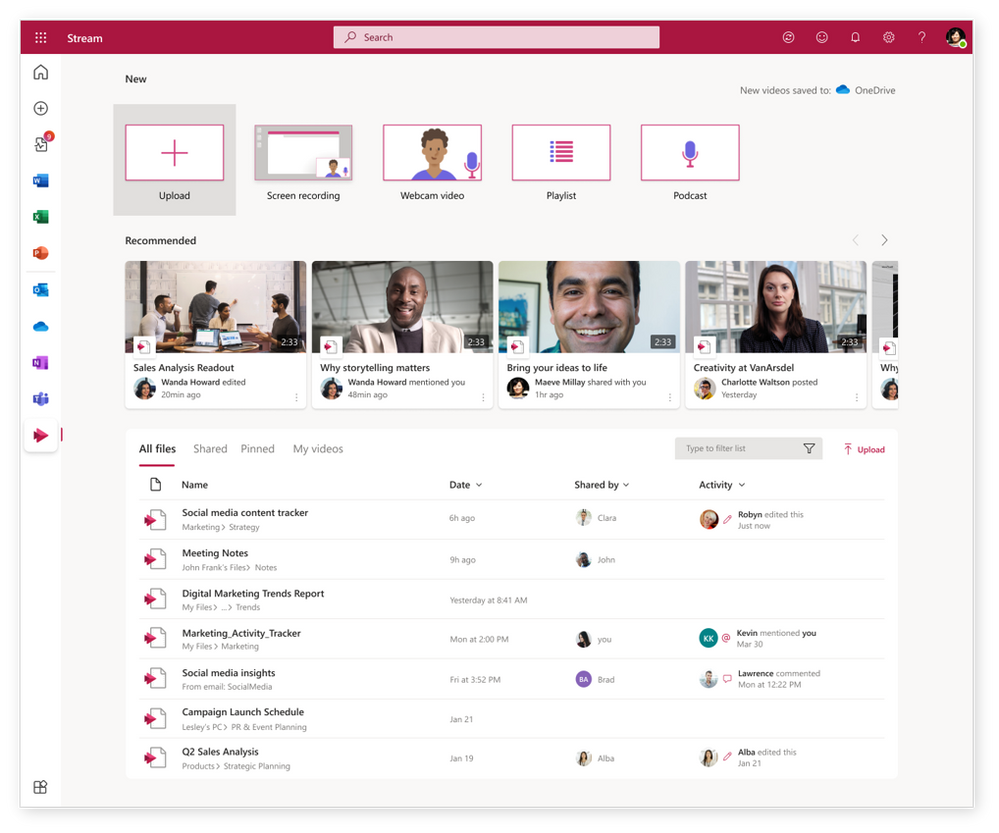
Stream start page: Videos now play directly in many Microsoft 365 apps. But when you want to do more with video, you can go to the Stream start page in Office. Here you can search for videos, see meeting recordings, view recommended or shared videos, view the videos you have created, and record or upload a new video. Learn more.
Search: Currently with Microsoft Search, you can search the video content of your entire organization for keywords that might appear in the title, description, chapters, or transcript. Early next year, we are adding the capability to search within a video transcript while you are viewing the video. You can then scroll through the search results and click on a portion of the transcript to be taken to that respective spot in the video. This feature helps you quickly get to the portions of the video that might be most important to you.
Videos in Yammer and Viva Engage: When you paste a link to a video from Stream (on SharePoint) into Yammer or Viva Engage, a linked thumbnail appears and the video will play directly in line as part of the post or storyline. That means the videos are playable directly inside of Viva Engage app in Teams, and if you have notifications sent to email, videos in the posts play directly in Outlook as well. You can also create and share images and short videos directly as a Viva Engage storyline post, letting you make deeper connections with people across your organization.
Embed: You can now grab an iFrame embed code from a video in SharePoint or OneDrive and embed it into another site for people within your organization to view. Embedded videos require authentication to view and respect the permissions of the video file. Public embed codes are not supported. Learn more.
Video publishing: Stream (on SharePoint) gives you a number of publishing options. In addition to hosting videos on SharePoint pages, sites, and portals, you can also share videos in Yammer, Teams, Viva Connections, or via email in Outlook. In Microsoft Viva, videos, like news, get pulled into your feed or highlights.
Going mobile
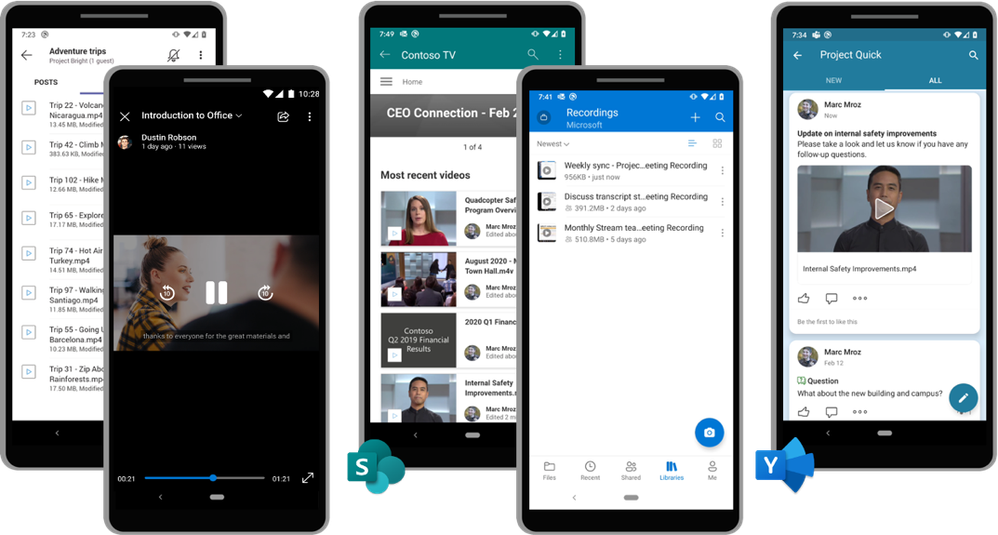
We’ve rebuilt the Stream app for iOS and Android to put all of your organization’s video and meeting recordings at your fingertips anywhere, anytime.
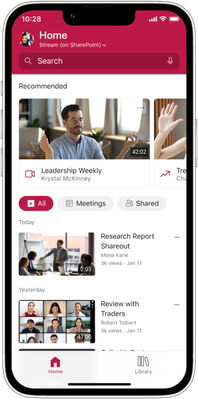
New Stream mobile app: When accessing Stream on your phone or tablet, you get a personalized home feed to see shared and recommended videos, meeting recordings, lectures, or collaboration updates. You can also mark important videos as favorites to easily find them again in your library. And to simplify the transition, you get seamless access to both Stream (Classic) and Stream (on SharePoint) video content.2
The rebuilt Stream mobile app began rolling out in October 2022. If you have the Stream app installed on your phone or tablet, it may have already updated to the newly rebuilt app. You can also manually update the app, download the Stream mobile app here for iOS and Android, or scan this QR code from your mobile device to download the app.
What’s new with video in Microsoft Teams
From rich meeting recordings to video messaging, Stream and Teams together help you create alignment and connection across hybrid and remote teams.
Teams meeting recap: Today, Teams announced intelligent recap, which, alongside meeting recap, helps you catch up on meetings you missed or ones you want to revisit. Meeting recap makes it easy for you to access all your meeting information, including files, recording, and transcript. And with intelligent recap, you'll see personalized insights on your Teams meeting recordings that help you discover the information that matters most to you. Here are three intelligent recap features that will help you make the most of your meeting recordings:
Personalized timeline markers that only you can see. These markers show you where you joined or left the meeting or when your name was mentioned.
Auto-generated chapters that let you jump to the precise moments that matter most.
Intelligent search that displays personalized suggestions for keywords and speakers so you can quickly get to a specific point in the recording.
Lastly, when you need to follow up you can share the recording at specific timestamps or keep the conversation moving forward with comments.
Video clip: The recently announced video clip feature in Teams allows you to record a short video message and send it via chat. These short, rich video clips are perfect for when you want your tone and authenticity to come through, or when you want to explain something visually. The recipient of the video clip can easily reply with a chat or create one of their own. Video clip is now available in Teams for commercial and education users in web and desktop clients and will soon be available in mobile. Learn more.
Making the move to Stream (on SharePoint)
All your existing Stream (Classic) videos can be transferred to Stream (on SharePoint) to take advantage of its rich integration within Microsoft 365.
Migrate from Stream (Classic): To support your move to Stream (on SharePoint), we have created a migration tool that helps you to transfer audio and video to SharePoint while also bringing over critical metadata and permissions associated with your Stream content. Additionally, the migration tool can redirect existing links to your Stream (Classic) videos so that those links point to the same content in its new location.
We will announce a retirement date for Stream (Classic) in early 2023. After that announcement, organizations will have 12 months to migrate their videos into SharePoint. See the migration and retirement timelines for more information.
We recommend you begin planning your migration soon by taking these steps:
Limit the number of new videos being added to Stream (Classic) and reduce your upcoming migration load, disable new uploads, and add a custom message to the top of Stream (Classic)
Help your users begin using Stream (on SharePoint) by changing the Stream tile in the Microsoft 365 app launcher to go to Stream (on SharePoint)
Have questions about the migration process? Join our customer office hours to get the answers you need. Enroll now for the twice-a-month Stream customer office hours.
Managing video content in SharePoint: With your videos stored in SharePoint and OneDrive, you’ll benefit from the security, admin controls, and information governance in Microsoft 365. Just like with documents, you’ll get eDiscovery, legal hold, retention polices, data loss protection, compliance, permission controls, and sharing controls on your audio and video files.
Engaging with the Stream product team: We’d like to invite you to join our customer connections office hours. In this twice-monthly meeting we answer your questions, share our plans, learn more about your video needs, and get your feedback. To get on the meeting invite list, you can sign up here: https://aka.ms/StreamConnect
We welcome your feedback. Feel free to comment below or share and vote on ideas in the Stream feedback portal.
1 We expect to announce a retirement date for Stream (Classic) in early 2023, and we’ll keep the service running for a full year from the date of the retirement announcement. See our retirement timeline for more information.
2 The rebuilt Stream mobile app currently lacks certain features that may be critical to some users, such as video recording, uploading and offline downloads. As we continue to build out the mobile app, we expect to add these features in 2023 for Stream (on SharePoint) videos.
3Public preview of the migration tool is currently available to all customers with the exception of GCC customers. However, some customers in the US, Canada, West Indies, & South/Central America may not have access to the tool yet.
We’ve rebuilt the Stream mobile app and the beta versions for iOS and Android are now available. The beta gives you early access to the new mobile experience which includes a complete design refresh, seamless access to Stream (Classic) and Stream (on SharePoint) videos, a personalized home feed, and a richer video viewing experience.
The Stream mobile app also allows you to search for videos across your organization, catch up on what you missed with Microsoft Teams meeting recordings, mark videos as favorites to easily find them later, and seamlessly share videos with your colleagues.
Features Overview
Use your personalized home feed to return to previously shared videos, meeting recordings and collaboration updates.
Search for any videos in the organization using keyword or Author name.
Catch up with missed meetings via the dedicated meetings filter on home page.
Mark important videos as Favorites and find them anytime from the library section.
Share useful videos with your colleagues with a tap of a button.
Seamlessly access both Stream Classic and Stream (on SharePoint) video content.
Do more, stay connected and learn with videos on-the-go. The Stream mobile app (beta) gives you seamless access to your video content on Stream (Classic) and Stream (on SharePoint).
Try the Beta App
Ready to try the beta version of the Stream mobile app?
We welcome your comments and feedback which can be left below this blog post, sent directly to streammobapp@microsoft.com, or by using the “send feedback” option in the app which can be found in Left navigation pane > Send Feedback.
We expect the general release of the new Stream iOS and Android apps to begin rolling out later this calendar year. If you currently have the Stream mobile app installed on your phone or tablet, you will receive the updated app when it becomes available in your region.
Note: Both the beta and general release of the Stream mobile app will lack certain features that may be critical to some users, such as video recording, uploading and offline downloads. As we continue to build out the mobile app, we expect to add these features in 2023.
What’s new with video in Stream, OneDrive, and SharePoint
Video on demand and meeting recordings have become paramount to helping hybrid and distributed teams get work done. With video on demand, you can take required training, view a previously recorded event, watch a message from leadership, or find internal how-to content when you need it. And, when busy schedules or multiple time zones make meetings difficult, you can catch up on what you missed by watching a Teams meeting recording. Video on demand creates invaluable flexibility and freedom to get your work done, on your time.
Today we’re announcing a set of features in Stream (on SharePoint) that enhance your video viewing and recording experiences across Microsoft 365. While some of these features have been available in Stream (Classic), they are now available across many apps in Microsoft 365 when you upload videos to SharePoint, OneDrive, Teams, or Yammer. These enhancements will help you use video more seamlessly in the flow of work. Let’s take a look.
Video captions and transcripts for all
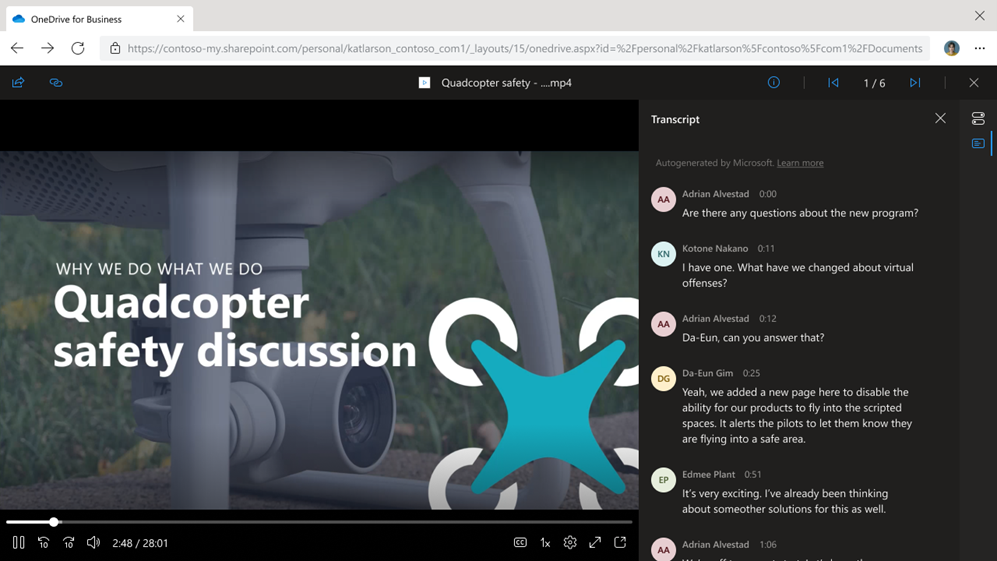
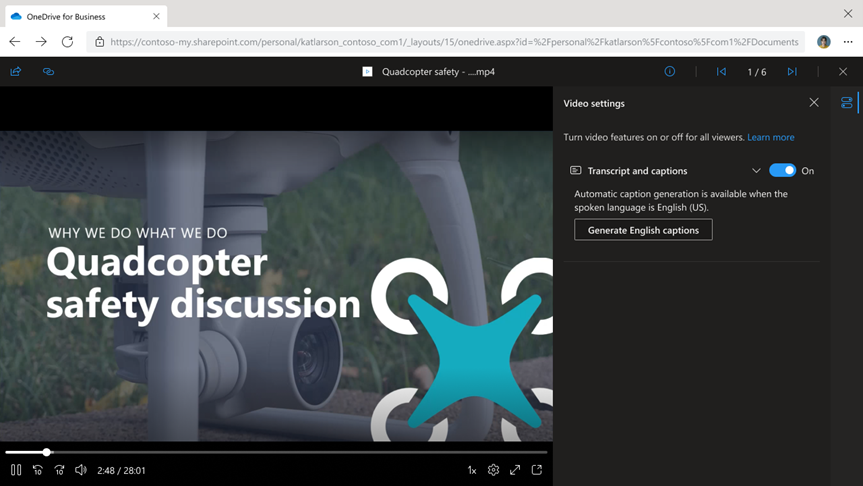
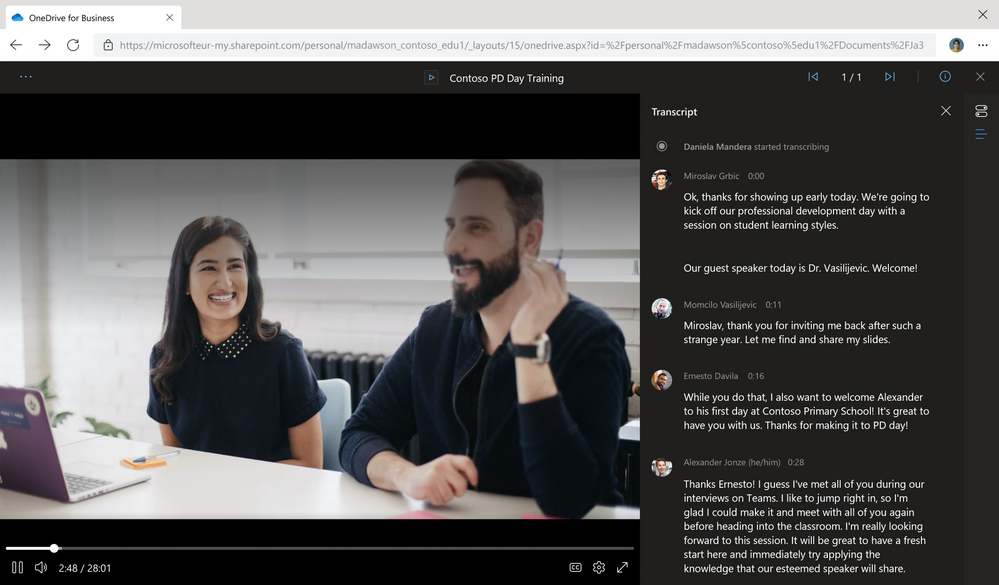
Earlier this year we introduced transcripts with speaker attribution for Microsoft Teams meeting recordings. Today, we’re happy to announce that you can quickly generate a transcript in English for any video file stored in SharePoint or OneDrive at your work or school, 1 and soon you will be able to generate transcripts in 20 other supported languages. Transcripts and captions are highly useful for people who work in noisy environments or who have hearing disabilities. Transcripts also foster productivity by making it easy to scan and find the most relevant content. And, by clicking on the text in the transcript, you can quickly jump to respective points in the video. The transcript can also show up as closed captions on your videos, which viewers can turn on or off by selecting the CC option in the player controls during playback. Lastly, transcripts assist in search. Searching in Microsoft 365 finds videos not only based on title and description, but also on the text in the transcript. Learn more about viewing, editing, and managing video transcripts and captions.
Video transcripts appear in the transcripts pane of the Stream player. Closed captions can be viewed by toggling closed captions to “on.”
Offline caption and transcript editing
Many customers have asked for the ability to edit video transcripts so they can ensure captions appear precisely on screen. Now you can edit closed captions and transcripts for any video stored in OneDrive or SharePoint. To edit a transcript, you download the existing transcript file, edit it offline, and then upload it back to the video. While manually managing transcripts like this is an important first step, we’re also working to enable editing directly in the transcription pane by the end of the year. Learn more about editing video captions and transcripts.
Skip the noise or skip forward
Stream’s new noise suppression feature dampens background noise in audio and video files so you can focus on the speaker’s voice. If you recorded a video in a noisy environment, you can set this as the default for your viewers, so they can hear your voice better. Or, viewers can turn on noise suppression themselves if they want to isolate the speaker’s voice from background music or other noise. The Stream player also now features a button that skips you 10 seconds forward or backwards in the video.
Jump right to the part of a video you want to watch with chapters
You can now manually add chapters on all videos and audio files stored in OneDrive or SharePoint. Chapters divide a video into sections, each with a preview thumbnail and title. These help viewers quickly identify and jump right to the part of the content they need. Adding chapters is also helpful for people who want to quickly understand what the video or audio file covers. To add chapters to your video or audio file, open the video settings pane in the player and toggle on the Chapters option. Then, select “Chapters” from the side pane, navigate to the part of the video or audio file you want to start a chapter, and select “Add new chapter” to begin building the chapter list. Learn more about using manual chapters with videos on Stream (on SharePoint).
Adding chapters to your videos helps viewers easily navigate to a section of the video that is important to them.
Collaborate with comments on video and audio files
Now you can add comments to video and audio files just like you would in an Office document. Commenting is especially valuable for asynchronous collaboration, providing feedback, or asking questions about the shared content. Comments are just the beginning of our collaboration features for video. We’re also working on time-synced comments and @mentions, so you can easily draw someone’s attention to a specific part of a video or audio file without them having to scan for what they need. We expect to launch these two features by the end of the year. Learn more about adding comments to a video.
Leave comments on videos to provide feedback, ask questions, or make suggestions.
Add custom thumbnails, titles, and descriptions to video and audio files
Thumbnails are the preview images for your video or audio file. They telegraph the content of the video or audio file and entice viewers to click the play button. You can now set a custom thumbnail for any video or audio file stored in SharePoint or OneDrive. Anyone with edit access to a video can upload an image or pick a frame from the video. In addition to custom thumbnails, anyone with edit access can also add or edit a title and description for the video or audio file. The title and description provide more context for your file when it appears in search and when it’s played. Descriptions are rich text, so you can add bold, italics, underline, bullets, and hyperlinks. Learn more about setting thumbnails, titles, and descriptions.
You can now add custom thumbnails, titles, and descriptions to videos in OneDrive and SharePoint.
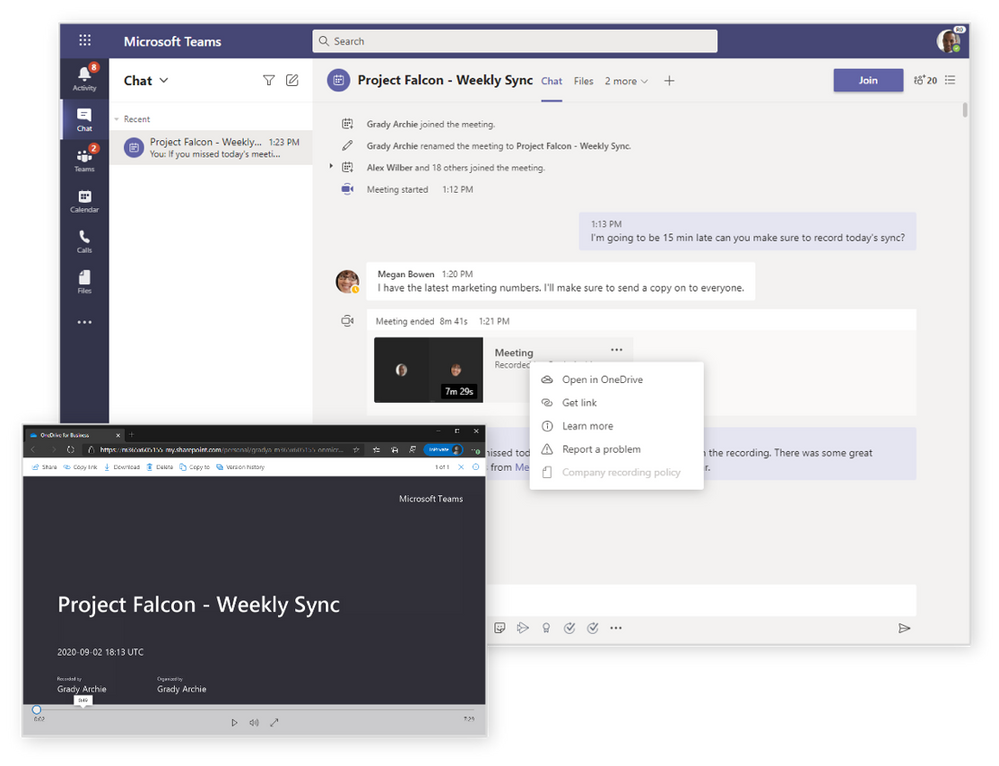
The above-mentioned features are also available on Teams meeting recordings (stored in OneDrive or SharePoint).2 You can find links to recordings in the meeting chat or on the Stream start page for any meeting that you were invited to and that was recorded. Also, in August Teams will debut video clip. This feature allows you to easily record and send a short, lightweight video message in chat, making a lasting impression and capturing a viewer’s attention as opposed to plain text.
Share videos externally with anyone links or guests
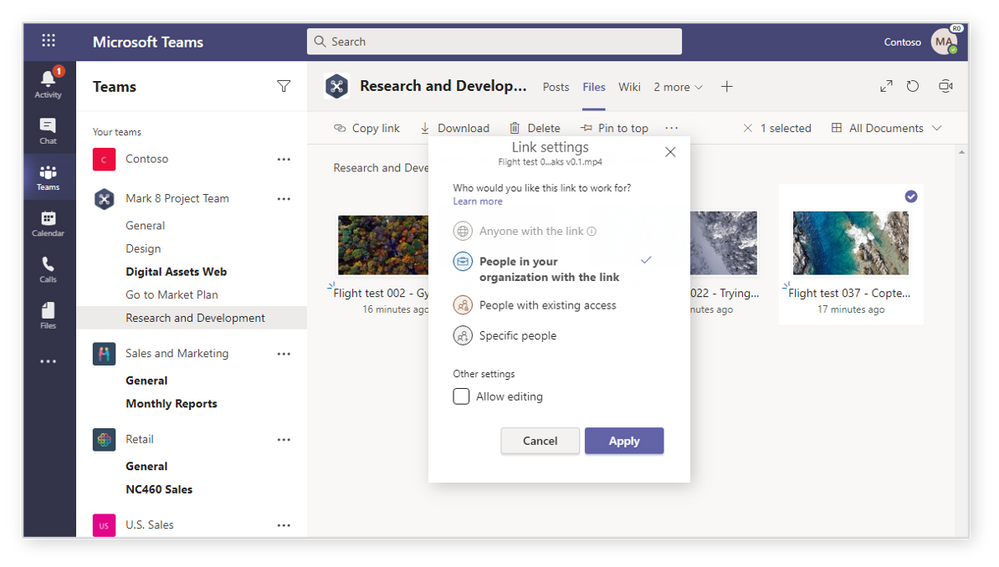
If you need to share a video with people outside of your organization, you can do that today with Stream (on SharePoint). When your video or audio file is uploaded to OneDrive or SharePoint, all the same permissions and sharing options as other files in Microsoft 365 are also available for video and audio files. Guest members to a Teams team, Yammer community, or SharePoint site will have the same audio and video player experiences for any audio and video files uploaded there. If your organization allows anyone links, you can share a link to an audio or video file with anyone. 3
A new home for video in Microsoft 365
Last year we announced that the new dedicated home for videos within Microsoft 365 is alongside your everyday Office apps at stream.office.com. From here you can find recommended, shared, and recent videos from across your organization. Now we are building upon this simple, comprehensive video discovery experience. In the coming months you will be able to keep a list of favorites, create playlists, and create new videos from stream.office.com. With the video creation experience you will be able to record from your camera or your screen, adjust your background, add effects, trim your video and then save it to OneDrive.
Stream Web App
Soon, we plan to introduce the Stream web app, which will improve viewing and publishing of video/audio files that are stored in OneDrive or SharePoint. The app launches in a browser when you open a video or audio file from stream.office.com, Teams, the embedded player, or when you open a share link.5
As a video player, the app works seamlessly with Office.com and brings key features of the Stream (Classic) to the Stream (on SharePoint) playing experience. Using it as a publication tool, you can add a title and description to your audio/video file, set a custom thumbnail, add chapters, generate a transcript, share videos, and even share your video at a specific time code. We expect the Stream Web app to begin rolling out to customers in August and to be available worldwide by September with GCC rollout following in October.
The Stream Web App is both a player and a publication tool.
Stream mobile app (beta)
We’re revamping the Stream for iOS and Android mobile apps. We plan to launch the beta version of the mobile app in the coming months. The app makeover will give you seamless access to your Stream (Classic) and Stream (on SharePoint) content along with a personalized home feed and a richer video playback experience. The new app will also include organization-wide video search, easy to find Teams meeting recordings, and video download for offline playback.
The Stream mobile app will give you seamless access to your video content on Stream (Classic) and Stream (on SharePoint)
Migrating from Stream (Classic) to Stream (on SharePoint)
For those ready to migrate content from Stream (Classic) to Stream (on SharePoint) we expect to launch the public preview of our migration tool in late- August 2022. When the migration tool preview goes live, you will find it as a tab in the Stream (Classic) admin center. For more information on using the migration tool see Migrate your videos and Migration tool details.
The Stream admin tool migrates audio and video content from Stream (Classic) to Stream (on SharePoint)
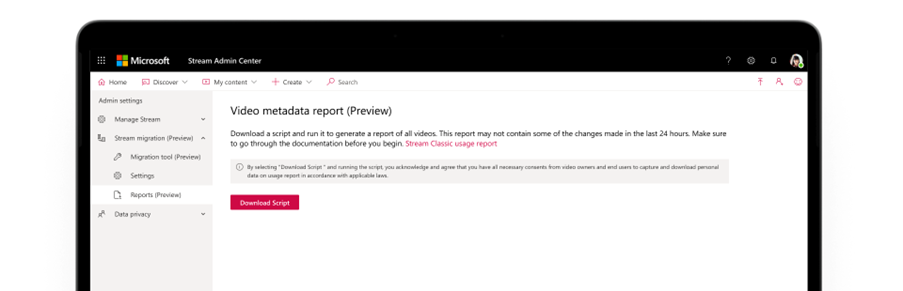
When the migration tool enters public preview, you will have access to the Stream (Classic) video metadata report that gives you inventory of all the videos in your tenant. You can use this report to plan which videos you want to migrate to Stream (on SharePoint).
The Stream admin metadate report will give you a report of all the Stream (Classic) videos in your tenant.
New for admins and SharePoint developers
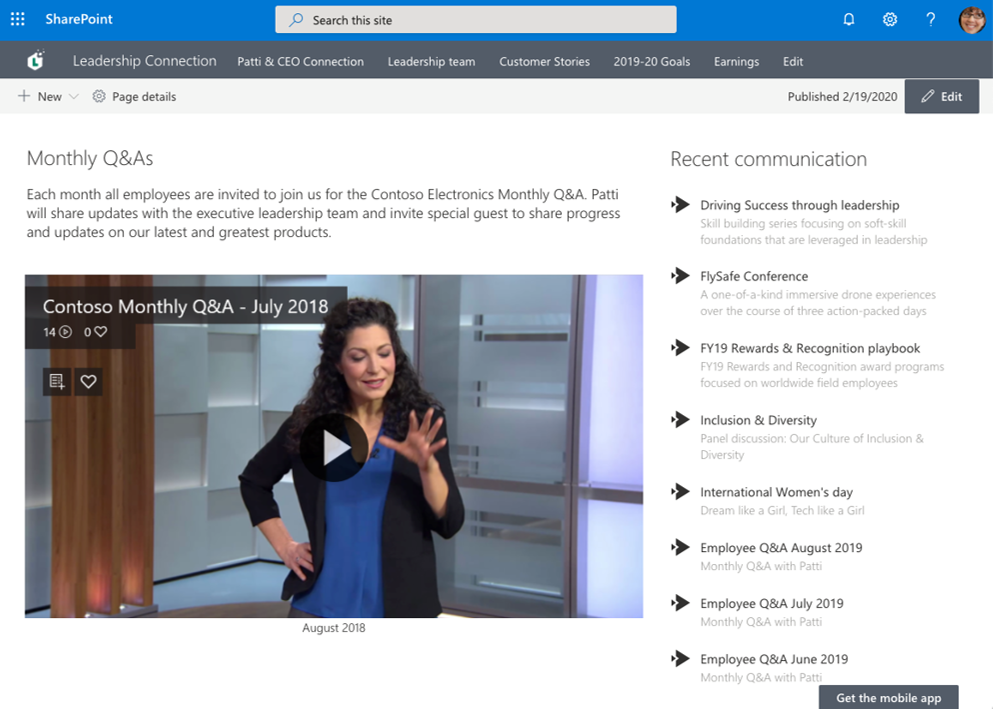
Soon, when users click to play a video in the Hero web part section of a SharePoint site, the video will play inline. This feature enables users to watch a video without being taken off the SharePoint page, learn more. Additionally, you’ll be able to gather and display all of the videos from a SharePoint site collection in one place. This feature is particularly helpful for educators who tend to share videos in Teams channels, learn more.
IT admins can now configure and set Teams meeting recording expirations to better manage storage and file governance, learn more. Additionally, users can extend the expiration date of meeting recordings if needed. Also, admins will soon be able to direct Stream app tile launcher to Stream.office.com.
All of the features shared above are just the beginning of the rich video experiences that Stream (on SharePoint) will bring to your everyday apps in Microsoft 365. Let us know what you think. Comment below or share and vote on ideas in the Stream feedback portal.
1 Edit permission is required on the video files to generate a transcript.
2 Requires Teams for Work
3 Requires administrator to enable external sharing for the organization or for a particular SharePoint site. 4 This feature may be turned off for your account. If you don't see the option, please contact your admin.
5 Currently videos stored in OneDrive and SharePoint will open and play in the OneDrive Player, we expect these files to open in the Stream Web app by October.
If you are creating or watching videos at work, you know that video is no longer just for employee training and corporate communications. Video is also being used for virtual events, to explain tools and processes, to capture and store meetings for those who can’t attend, to share knowledge, and to enhance documents, decks, and spreadsheets. Videos are powerful because they explain visually, tell a story, and create human connection. Microsoft Stream makes it easy to create enhanced videos and use them in the flow of your everyday work.
Video is becoming central to productivity in the workplace, serving a similar role as documents and slide decks. Creating and securely sharing enhanced videos with Stream is as simple as opening the app and tapping the “Create” button. Microsoft Stream is leading the way with enhanced video as a productivity tool by integrating it into your apps across Microsoft 365.
Today at Ignite, Chris Pratley and I shared several new features and capabilities for Stream (on SharePoint), along with deeper integrations with Microsoft 365. (See the Ignite presentation: Video and Microsoft Stream in Microsoft 365.) Let’s take a closer look at what's new and how Stream (on SharePoint) can empower you and your team.
Search and discovery
Video content across Microsoft 365 is now easier than ever to find.
New Stream start page
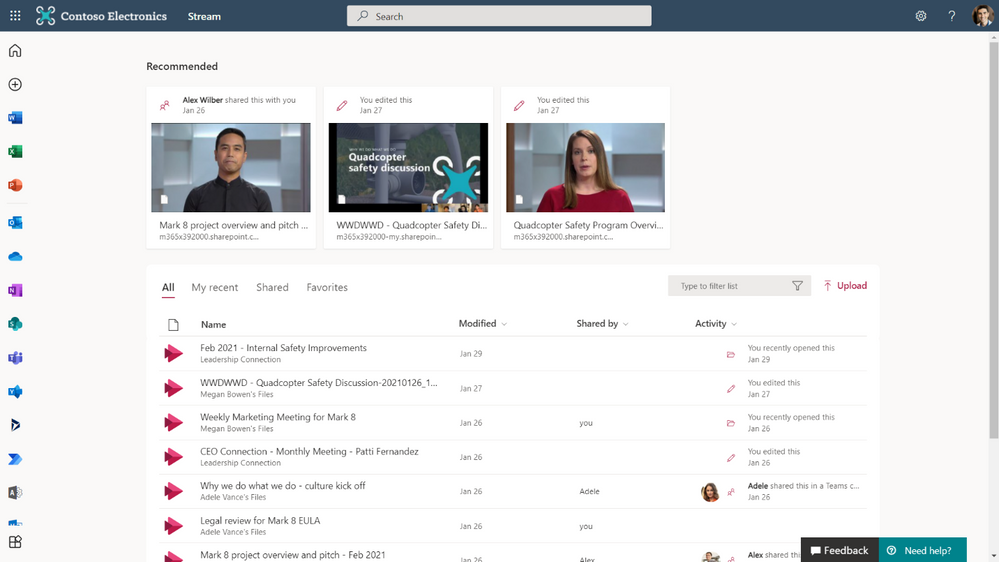
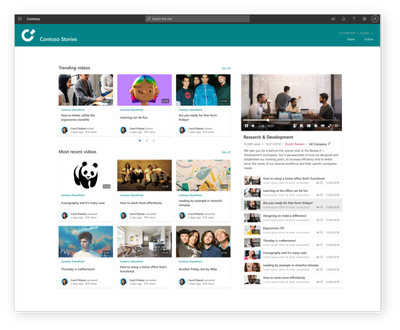
We’re creating a dedicated home for videos within Microsoft 365. If you go to stream.office.com, you can discover videos from across your organization in a single, comprehensive, and user-friendly experience. The new home for videos is personalized and shows your recommended, shared, and recent videos and meeting recordings—everything that is relevant to your work and interests.
The new Stream start page lets you quickly create a video or browse recommended, recent, shared, and favorited videos.
Videos in Microsoft 365 search
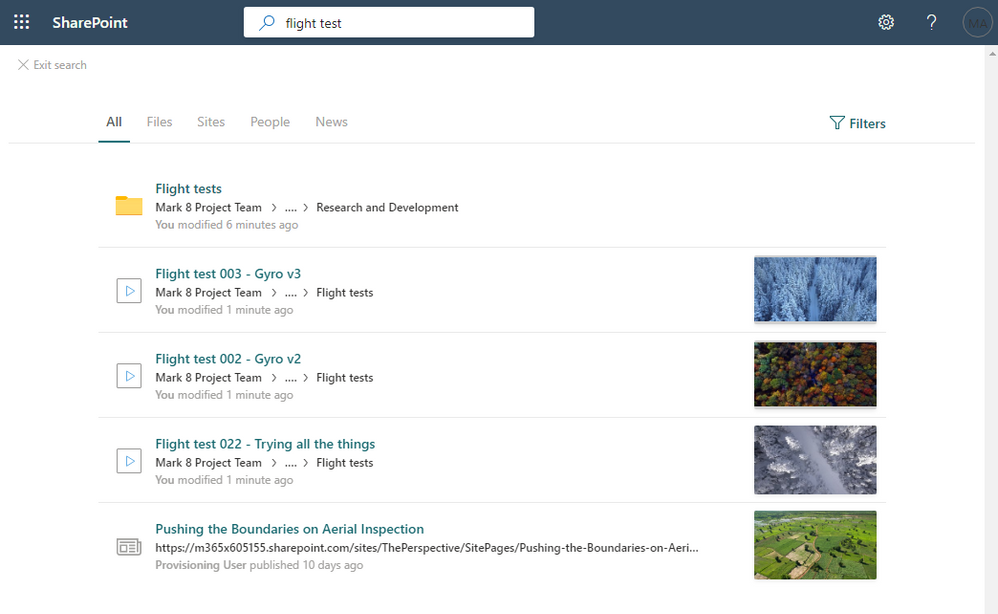
Stream videos are deeply integrated with Microsoft 365, which means that you can search for and find videos in Office, SharePoint, and Microsoft 365 search in Bing. Not only can you search for videos based on title and other metadata, you can also search based on what was said in the video. Your search term results will appear inside the transcript segment that featured them to provide context. To search for content in videos, go to Office, enter your term in the search bar, and then select file type “Video” to narrow your results to just videos.
Videos in SharePoint show up in search results based on keywords and words that were spoken in the video.
Recommended videos
Stream (on SharePoint) leverages the power of Microsoft Graph to surface videos in a recommended viewing list tailored to you. Your recommended video files show up in your Office home feed and in the recommended files section when you open a new tab in Edge. Additionally, when you click on a coworker’s profile card, you’ll see the files and videos related to them. These are just a few ways Stream is personalizing your video feed in Microsoft 365.
Video creation and consumption
Let’s take a look at new video recording and viewing features in Stream (on SharePoint).
Screen recording
Videos are an excellent medium for knowledge transfer in the hybrid workplace. Instead of writing out a document to convey instructions or processes, you can show how to do it with an explanatory video or a screen recording. Conveying information visually is more engaging and often simpler to follow than text in a document.
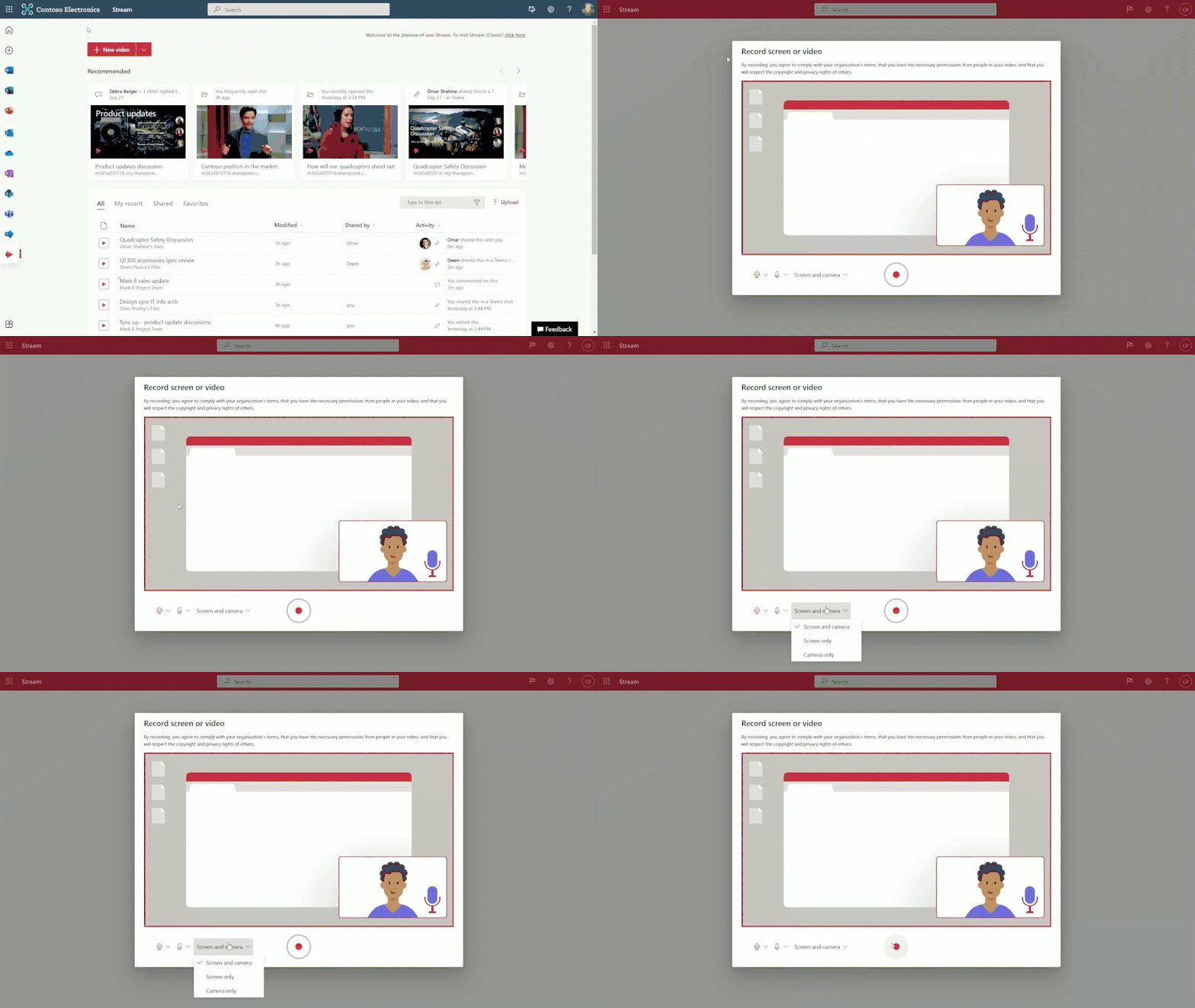
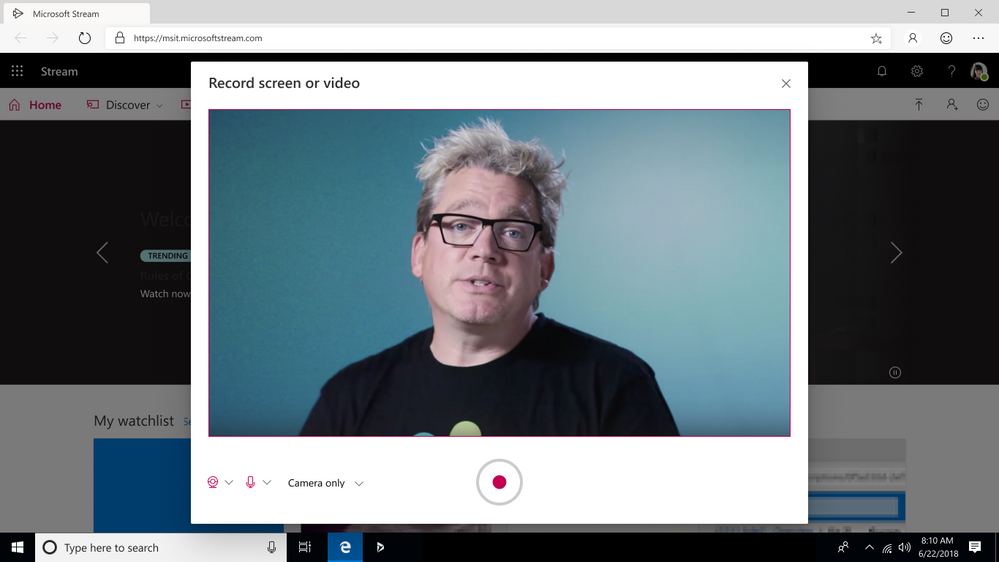
Soon you’ll be able to record your screen, record from your webcam, or both at the same time right from the Stream start page in office.com. This feature will be available in the coming months.
Recording a video from Stream is simple.
Updated video player
We all want our videos to play smoothly with high quality, no matter what network or device we’re using. We've been working hard to make that happen, and we’re happy to say that across Microsoft 365, videos are now faster to start up and play with less buffering than in the past. We’ve also added a visual table of contents to videos so that you can see the content at-a-glance and jump to relevant sections of a video. Additionally, we’ve added modern comments with @mention capabilities to draw someone’s attention to your feedback.
These playback enhancements give you more control and help save you time as you interact with videos across Microsoft 365.
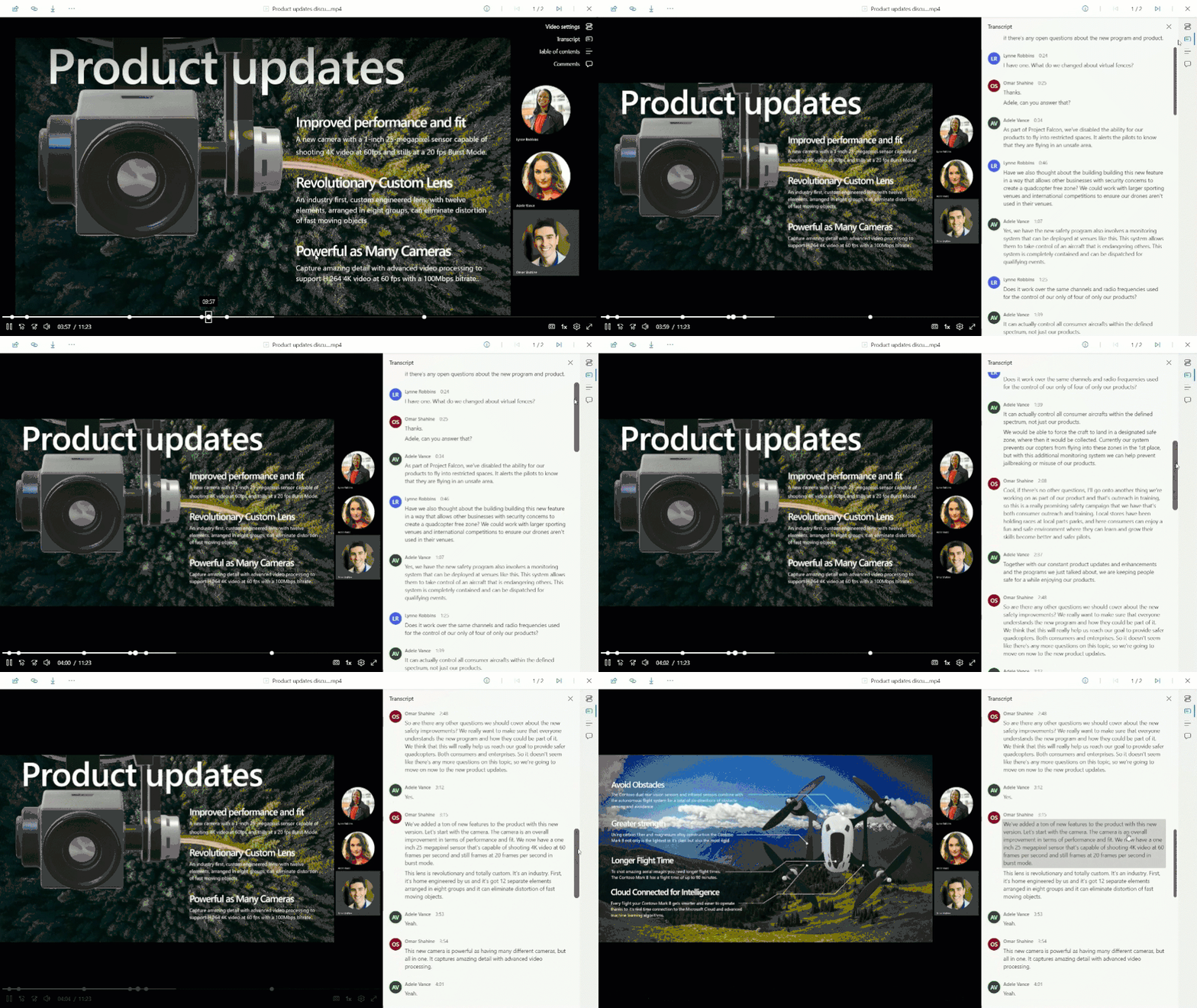
Stream videos offer transcripts, comments, table of contents, and playback speed controls.
Mobile video experiences
As promised, we're beginning to deliver improved video experiences on mobile across Microsoft 365.
On the Office mobile app for Android, you’ll now see Stream videos appear in your recent and recommended files, as well as in the media tab. When recording videos on the mobile app, you can now use effects such as overlays, text, and inking.
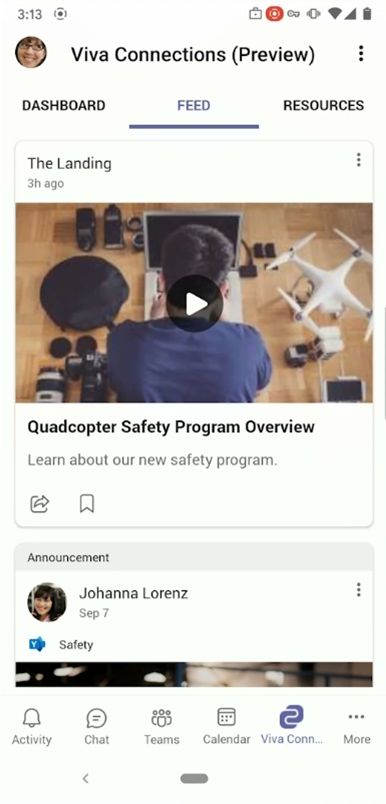
Microsoft Viva is an employee experience platform (EXP) designed for the hybrid era. It brings together communications, knowledge, learning, resources, and insights in the flow of work. Within Viva Learning and Viva Connections on the Teams mobile app, videos now play inline with Viva content.
Stream videos are now accessible in the Viva Connections app.
Teams meeting recordings
Recording meetings in Teams is an excellent way to review what you may have missed in meetings and to help others who could not attend catch up. Over the past year, we've shifted to saving new Teams meeting recordings to OneDrive and SharePoint to provide better governance and sharing options. We’ve also rolled out several accompanying improvements. Our newest improvement is multi-speed playback for Teams meeting recordings to review and catch up quicker. We expect this feature to be live for all users worldwide by the end of November.
Additionally, Teams meeting recordings now deliver high-quality transcripts with speaker attribution for meetings that have Teams Live Transcription turned on, and the meeting recordings are indexed into easier-to-consume segments based on slide transitions. Playback is also enhanced on the Teams mobile app where you have faster startup and multi-speed playback.
Teams meeting recordings now support multi-speed playback and deliver transcripts with speaker attribution.
New video distribution channels
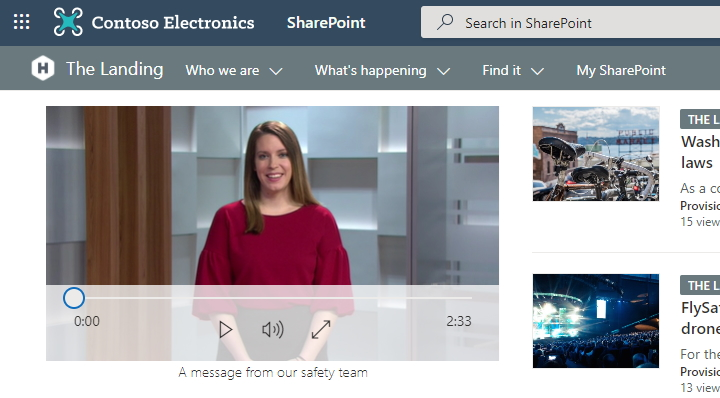
Many of you have asked us to make it easier to produce customized video portals and corporate communication sites. To this end, we’re updating SharePoint web parts so that they offer better video integration with your modern SharePoint sites.
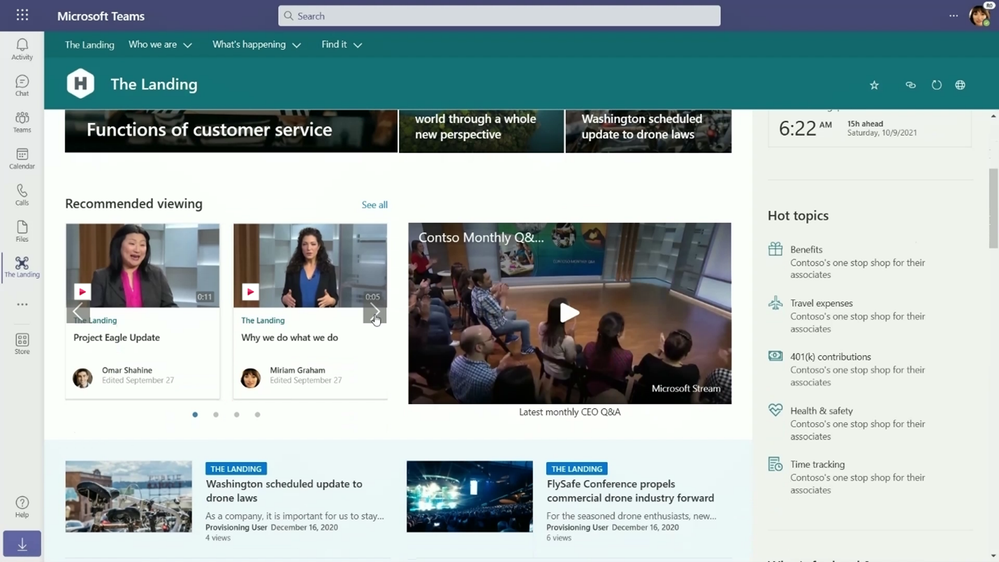
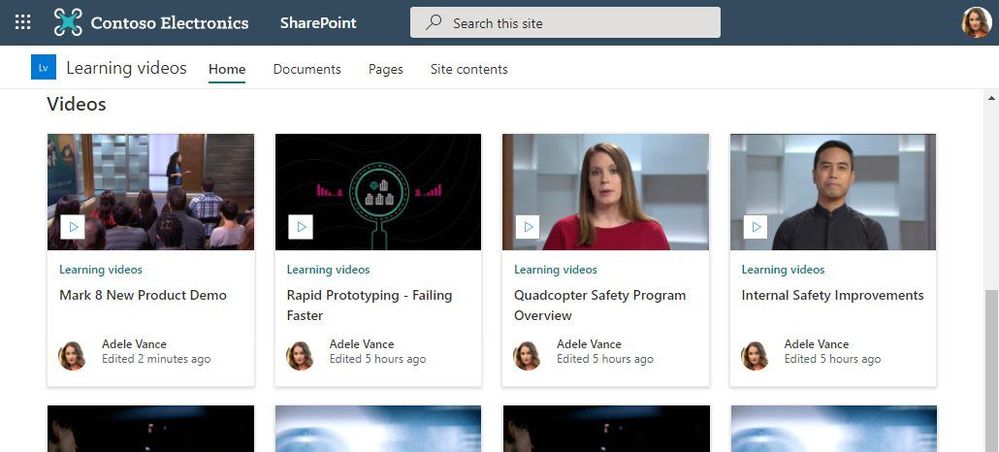
Add Stream video to your modern SharePoint portals.
We have scenario-based help guides available now to walk you through adding hero videos on your modern sites. In the future, we'll make this even easier by providing enhanced video web parts such as galleries and carousels. We are working on site templates that feature videos beautifully, alongside articles and other content, and retain all the rich customization and branding capabilities of SharePoint.
Microsoft Viva Connections
Corporate communications teams can insert videos into Viva Connections for more engaging communications, and even schedule the posting so that video messages show up in all the Viva touchpoints at a certain point in time.
Stream videos can now be included in Viva Connections.
Viva Connections is a great way to reach employees with a curated, company-branded experience that brings together relevant news, conversations, and resources in the apps and devices you use every day.
Updated security and compliance
We've heard from many customers that compliance is just as important as innovative video experiences. Recordings and other videos often contain sensitive information that needs to be managed appropriately. We’re happy to say that all videos in OneDrive and SharePoint, including meeting recordings, have the same basic governance policies (eDiscovery, Legal Hold, Retention, DLP, etc.) as other document types in Microsoft 365.
Stream (Classic) migration tool preview
We are releasing a private preview of the new Stream migration tool that will help you move videos from Stream (Classic) to Stream (on SharePoint). The tool will maintain permissions, redirect links, and embed codes for any Stream (Classic) videos referenced in sites and documents. If you’d like to enroll in the preview visit: https://aka.ms/StreamMigrationPreviewSignup. Customers selected for the private preview will get access to the tool later this month. Note: This private preview is available only to subscribers who are outside of the European Union and China.
The Stream migration tool will soon be available in private preview.
As we continue to deliver more video experiences in Microsoft 365 and formally release the migration tool in 2022, we will communicate timing around a retirement date for Stream (Classic).
What's Next?
We’re building Stream to empower you to communicate, connect, and learn. Our long-term goal is to make video a mainstream format that’s as easy to create, consume, and manage as text in documents. As we work towards this goal, we’ll be bringing video to the Microsoft 365 apps you use every day, and we’ll be improving performance, search, accessibility, and playback/recording controls.
We know that transcripts are an important tool to help you achieve more with video – whether searching across Microsoft 365 to find a video, scanning a video to find a specific spot, turning on captions while you watch in a noisy environment, or using subtitles to follow along in another language. As we continue to build Stream (on SharePoint), we’re excited to share the next set of transcript capabilities that will help make video in Microsoft 365 more accessible and productive.
Finding and Viewing Teams Meeting Recordings
Throughout the past year, we’ve been able to stay in touch and collaborate with colleagues in Teams meetings. During this time, we’ve found that recording these meetings has been super helpful in letting us catch up and recall details later. We also find the recordings are easy to share with colleagues who couldn’t attend in real time or work in different time zones. To support these scenarios further, Stream will soon begin displaying transcripts alongside the Teams meeting recordings when Teams Live Transcript is also enabled. This feature is currently rolling out (Roadmap ID 82057), and will show the transcript in the language it was recorded in.
Transcripts in meeting recordings can be quickly scanned to jump to any point in the video, helping viewers find content most relevant to them. Meetings are transcribed in higher quality by leveraging text in the meeting invitation, participant names, and attachments to better recognize and transcribe what was said.
We’re also making it easier to find this content anywhere from Microsoft search. For any meeting recording you have access to, you can find that meeting recording based on what was spoken in the transcripts. This feature is currently rolling out (Roadmap ID 82003).
Generating New Captions
Video captions make videos more accessible and easier to follow along, so we’re working to enable you to easily add captions to your video with the click of a button. This is an important feature for video viewers who are deaf or hard of hearing, have different language proficiencies, or are just listening in from a noisy environment.
Initially we’ll caption content when the spoken language is English, which will be followed by support for many additional languages. We’re also following up with the ability to view spoken words in the transcript pane as well; an approach we know many viewers prefer to use to catch up more quickly!
Manually Uploading and Editing Transcripts & Captions
Sometimes you need to have more control over the transcript and captions that accompany your videos. This might mean editing the transcript file to correct mistakes, or uploading a custom transcript file your team has created for a special video. We’ll empower you to add your own Video Text Tracks (VTT) file in any language. You can also download an existing transcript file, edit it outside of Stream with a text editor or VTT editor, and then upload the corrected version to ensure the highest level of transcript accuracy.
This feature will begin rolling out in early 2022 and followed by the ability to store multiple transcripts with a video. At which point, viewers will be able to select the language they want in either the video player captions or the transcript pane!
More Features Coming Soon
While we’re delivering these features to lay a solid foundation for Stream (on SharePoint), we remain committed to making video capabilities more accessible and productive in even more scenarios. We’re continuing to work on the next set of transcript features, including the ability to quickly search transcripts, edit and make corrections on the fly, additional transcript controls for video owners and admins, and automatically generating transcripts and captions more broadly to empower you to achieve more with video. Feel free to comment below and let us know what transcript features are most important to you!
Since we first announced users could save Teams meetings recordings in Microsoft 365, we’ve clocked immense progress - with most users now saving their Teams meetings recordings by default on OneDrive and SharePoint than on Classic Stream. With this switch, users are enjoying many new benefits from meeting recordings being better integrated with Microsoft 365, including: easy share controls and external sharing capabilities, improved video management, advanced compliance and governance, and much more.
In line with the vision for Stream (built on SharePoint), and to bring these increased benefits to all our users, all new Teams meeting recordings will soon be saved to OneDrive and SharePoint – with rollout beginning incrementally from August 16, 2021.
Major updates to transcript coverage and controlling downloads.
Central to the changes we're making are our users' needs. Thus, alongside our efforts to transition meeting recordings to Microsoft 365, we've been gathering your feedback - resulting in the following product updates and feature accelerations to ensure a more accessible and secure product:
Generating Teams live transcription for all meetings to ensure closed captions are available during playback in Microsoft 365:
Rolling out by August: Live transcription will always be generated when a user clicks ‘Start recording’ on desktop client.
Rolling out by August: Live transcription will be available across all meeting types, including channel meetings and ad-hoc meetings.
Rolling out by August: Live transcription and live captions will be available for 15 additional spoken languages.
Downloading and editing a transcript file:
Available today: Users can download the transcript file from the Teams meeting ‘Transcripts’ tab, where users can edit and share the file manually with others.
Under development: Improvements to the above flow by allowing users to download the transcript file from the video player itself, make changes locally, and upload the file to the player so that the changes are reflected in the closed captions.
Other immediate options to edit transcripts within the video player: users can download recordings from ODSP and upload to Classic Stream, where a transcript will be generated on-demand and users can edit the transcript within the video itself.
If you have questions about this or other features, please contact support through your M365 Admin Center or your account manager.
Blocking the downloads of meeting recordings is now available for all users in ODSP:
Available today: Block downloads for non-channel meeting recordings has been rolled out and turned on by default for all recordings.
Available today: Block downloads for channel meeting recordings has been rolled out and admins may enable this feature through a new Teams policy setting.
To learn more about these updates, admins can see Message Center post 222640. Microsoft is excited about these updates that will bring higher quality and more accurate transcription to more people and languages than ever before.
What else is happening with Teams meeting recordings stored in Microsoft 365?
The changes above fall within the broader context of the work we’re doing with Stream (on SharePoint). Several other features have begun lighting up for Teams meeting recordings stored in Microsoft 365 including:
Now available: Auto-recording –Meeting owners can set meetings to automatically start recording.
Now available: Stream start page–Search and manage meeting recordings from the new Stream start page (stream.office.com)
Rolling out: Stream video player – Watch recordings from the new Stream web player.
Rolling out: Variable playback speed – Watch recordings at faster speeds (0.5x - 2x).
Under development: Auto-expiration of meeting recordings –learn more about this feature.
To learn more about these, and other upcoming features for Stream (on SharePoint), click here.
In a nutshell, be ready for new experiences with Teams meeting recordings in Microsoft 365.
Rolling out incrementally beginning August 16, 2021: All meeting recordings will be saved to OneDrive and SharePoint. We recommend that customers roll out the feature via their Teams policy in PowerShell before this date to control the timing of the release.
Over the years, as students and educators have headed back to school, there's been an ever-constant need for reliable tools that help foster learning and development. As a core enabler of remote and hybrid learning, video has become central to education in the last year, providing an authentic, engaging medium that best captures the in-class experience today.
Microsoft Stream (built on SharePoint) is bringing to production long-awaited features that unlock new value for you in the areas ofaccessibility, security, and customized content consumption.
Accessibility
We're complementing recent Teams meeting accessibility enhancements with improvements to transcripts and captions in Stream on SharePoint. This summer, we'll show transcripts alongside any meeting recording that came with Teams Live Transcript. Then we’ll add the ability to upload your own transcript to any other video stored on OneDrive and SharePoint, which is also used to drive captions and subtitles. After that, we’ll be adding the ability to generate a new transcript for a Teams meeting recording or any other video that has already been saved to OneDrive or SharePoint. This provides on-demand accessibility even for meetings where live transcription was not available or used.
When: July-September 2021
Security
When it comes to a video reaching its intended audience, there exist many key considerations – from privacy and intellectual property security to preventing unauthorized access to class content. We've heard from you how much of a priority this is. To address this, we're making Teams meeting recordings read-only by default and will add “block download” functionality to Teams meeting recordings that are automatically saved to OneDrive and SharePoint.
This feature provides greater control over how meeting recordings are accessed and shared and will roll out initially to non-channel Teams meeting recordings – with channel recordings following a few weeks later.
When: July-August 2021
Content consumption
While video has many advantages over its alternatives, its discovery, distribution, and consumption can be challenging for educators and students alike. The Stream web app will soon be part of office.com - consolidating videos into a seamless, individualized experience for all stakeholders. We'll also release a new player for video files in OneDrive and SharePoint, including several upgrades for playback such as higher quality video, a transcript pane on the right, speaker identification in the transcript (if enabled), and support for switching between transcripts in multiple languages.
When: June-August 2021
Other features
Most of the features mentioned above are arriving by August, but you can use Stream on SharePoint today. All your videos on OneDrive and SharePoint, whether they are Teams meeting recordings or video files you've uploaded, are Stream videos, and we'll continue working to deliver the high-quality playback, features, and scale you expect.
By the way, this is just one announcement among many for May the Fourth (Teacher Appreciation Day!). To read about more of the 68+ new features announced today across the Microsoft 365 suite that benefit education, here are links to the primary blog posts.
** The earlier version of Stream will now be known as Microsoft Stream (Classic) and Microsoft Stream will continue as the name for the new version.
In the past year, we've seen explosive growth for video in the workplace. Video has become central to engagement, communication, and productivity as more organizations than ever before embrace asynchronous work.
Leading the evolution of workplace video, the Microsoft Stream team embarked on a journey to integrate fast, intelligent video across Microsoft 365. We announced a new vision for Stream—one in which users can create, share, discover, and manage video —just as they would any other file in Microsoft 365. As we set off on this journey, we identified four key milestones to reach:
saving meeting recordings to Microsoft 365
achieving high-quality playback and scale parity with Stream (Classic)
bringing innovation to the new version of Stream
migrating existing Stream (Classic) customers
We're glad to announce we'll be entering the next phase of our journey to the new version of Microsoft Stream in Q3 2021. In this phase, we're on track to start bringing new experiences for sharing, discovery, and video playback on top of the Microsoft 365 file experience.
Here’s a breakdown of the Microsoft Stream journey below:
Teams Meeting Recordings Saved in Microsoft 365
The first step on this journey was to improve Teams meetings recordings by saving them in OneDrive and SharePoint, like any Office file. This has helped unlock new value and many long-awaited features for our customers. We’ve since taken steps to address limitations associated with this change by answering many of the questions we received and will be rolling out a block download feature for non-channel meetings. For more information on Teams meeting recordings in OneDrive and SharePoint: https://aka.ms/tmrodsp
Playback Quality and Scale
The next step on this journey involves bringing high-quality playback and scaling from Stream (Classic) into video across Microsoft 365—including Teams, OneDrive, and SharePoint. Alongside core processing and playback improvements, we're adding Content Delivery Network (CDN) support for video playback. These are the first few improvements expected to roll out in this phase - with continued investments in this area over the coming year, including a new and improved video player
Advancing Stream Innovation
In Microsoft 365, video files get compliance, governance, and immediate access to the many file innovations available to other Office file types, not just today but also in the future. This means the Stream team can focus more innovation on video and audio experiences across Microsoft 365. The first of these coming to the new version of Stream include videos on SharePoint pages, the Stream web app, and improved video analytics.
Featuring videos on SharePoint pages
When you upload video files to SharePoint Online sites, OneDrive for Business, Microsoft Teams, or Yammer communities, you can easily build modern pages with existing web parts in SharePoint sites to feature those videos for your viewers. See how you can create beautiful pages featuring videos uploaded to the M365 files experience today.
Stream web app
The Stream web app will soon be part of office.com, bringing together videos from across your organization, and providing a consolidated list of videos shared by other users. Users will also be able to create, upload and find videos, with the entire user experience - along with search - tightly integrated with the rest of Office.com
Improved video analytics
For creators and admins, we are working on analytics that provide deeper insight into video engagement and interaction. This includes a viewership heatmap developed on top of analytics already available in Microsoft 365 today.
Migration
At the migration step, we’re taking a two-pronged approach—help customers prepare and make migration as pain-free as possible. Along these lines, we plan to release detailed migration documentation in March 2021 and the migration preview tool in summer 2021.
In summary, we’ll start bringing new experiences for sharing, discovery, and video playback on top of the Microsoft 365 file experience from Q3 2021. As we power through the next key milestones on this journey, we remain resolved to deliver an exceptional product experience, continue supporting Stream (Classic) customers, and advance innovation around fast, intelligent video. Check out the support documentation below for more information and follow the Microsoft 365 Stream roadmap to stay up-to-date with changes coming to Stream.
Microsoft Stream (Classic) now includes new features that deliver better video experiences across all of Microsoft 365.
Fast Embed
The Microsoft Stream team has replaced our old embed player with an improved version called Fast Embed. This means users will experience faster-loading times for all Stream videos embedded across Microsoft 365 applications.
Wondering how fast it is? Expect up to 25% reduction in the time it takes an embedded video to load, and up to a 90% reduction in the time it takes for the video to start playing.
Webcam-only Recording
We've rolled out webcam-only recording to Stream (Classic) customers. This update gives everyone an additional way to create videos for training, knowledge sharing and communications across the organization without downloading additional tools or software.
Video is more important than ever in the modern workplace.
Video empowers people to connect authentically, share knowledge, and drive communication, training, and employee engagement. For these reasons and more, video continues to play an increasingly central role for work—transforming communication and collaboration like never before.
At Ignite 2020, we announced a new journey for Microsoft Stream. This journey begins with a vision for Microsoft Stream: to bring intelligent video creation, sharing, and viewing to all parts of Microsoft 365, while empowering users and administrators to manage video just as they would any other file. This vision elevates video as a primary content type in Microsoft 365, building on the rich content management features of SharePoint, and unlocking the intelligence of Microsoft Graph, to deliver long-awaited features including external and anonymous sharing, integration with Microsoft Search, enhanced analytics, and new controls for security and compliance.
A one-stop shop for creating, editing, managing, and discovering videos, the Stream web app helps users seamlessly create, edit, and playback videos. Also, the Stream web app presents users with recommended videos from across their organization, and provides a consolidated list of videos shared by other users. The web app will be part of office.com—like Word, PowerPoint and Excel web apps—and will enable users to discover, share, and manage videos like any Office document.
Improved playback for video in Microsoft 365
The new Stream will bring the same high quality and scalable playback quality that exists in classic Stream today to all video in Microsoft 365. The new Stream will build on the existing familiar playback page by adding and improving features—more accurate transcripts with speaker attribution for meeting recordings, noise suppression, chaptering, and analytics.
This means in the future, users will get the same, high-quality Stream video experience for all videos across Microsoft 365.
Portals
Users will be empowered to create video experiences using SharePoint with new, out-of-the box templates for video-rich sites and portals. With wiki-like simplicity, users can create communications that combine video with messaging and other media to tell their story on any page or news post. These custom experiences will render across browsers and devices—SharePoint ensures content is responsive and accessible.
Mobile
In addition to the Stream app for iOS and Android, improved video capabilities will be coming to mobile applications across Microsoft 365. Create and upload short videos from your mobile device—securely, without storing corporate video on the device’s camera roll. And watch videos inline in your notification feeds, chats, and more.
Productivity
Microsoft Teams meeting recordings As a first step—rolling out this year—recordings of Teams meetings will be saved in Microsoft 365. This means meeting recordings will be stored and shared with OneDrive and SharePoint, like any Office file. This enables you to share meeting recordings with people inside and outside your organization like any Office file. The change also unlocks top customer requests including analytics and API-level access to meeting recordings.
Video search You can find videos in Microsoft 365 using Microsoft Search. Initially, videos can be found using the video’s name and metadata. Video-specific search experiences such as transcript search and video recommendations will follow as we transition to the new Stream.
Video analytics Today, file analytics for videos in OneDrive and SharePoint already offer view trends over time as well as audience and usage insight. In the future, we will go deeper with more video-specific analytics that will provide deeper insights into user, device, and content interaction.
Video management
Sharing and permissions Videos will follow the same sharing and permissions model as any other file in Microsoft 365. Users will have options to share with anyone outside their organization, people inside their organization, or with specific people, based on the sharing policies of the organization.
Admin capabilities As with end-user sharing and permissions, administrative settings, controls, reports, and other actions that apply to any file, SharePoint admins will retain the ability to act on content in any SharePoint site or any user’s OneDrive for Business.
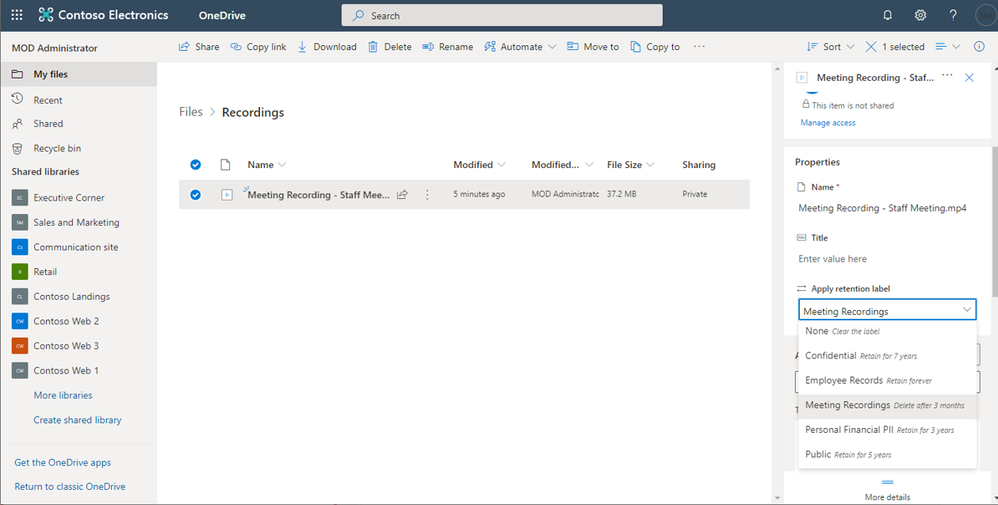
Governance We’ll be bringing information governance—like that available to other Office documents—to Stream. All video files inherit information governance features in Microsoft 365. Later this calendar year, Teams meeting recordings saved on the SharePoint files platform can get automatic retention labelling with appropriate licensing.
We’ll be investing heavily in this space in the future by adding specialized support for governance around meetings and videos in terms of eDiscovery on transcripts, legal hold, sensitivity labels, and more.
Storage management
In most organizations, Teams meeting recordings comprise the bulk of videos stored in Stream. We'll help users better manage storage with automatic retention polices and other features inherent in the new Stream.
Video extensibility
APIs for video One of the advantages of Stream’s deeper integration with Microsoft 365 is that, with video stored in the service, developers are immediately able to leverage existing APIs in SharePoint and Microsoft Graph to create custom video-centric applications and experiences. This unlocks new value for customers today, and as we build out the new Stream, we’ll create many more APIs for video.
Stream is evolving from a discrete set of experiences restricted to a subset of your organization’s video, to a powerful, integrated experience supporting the pervasive use of video across Microsoft 365. The journey to the new Stream starts today. We will unlock new value for customers in 2020, by elevating video to a first-class content type in Microsoft 365—enabling users to share and manage video like any other file. Customers who want to create future-proof video experiences in Microsoft 365 can start building them today with SharePoint and Graph File APIs.
In the first half of 2021, we will bring to the new Stream the high-quality playback and features that customers enjoy today in classic Stream. The new Stream will be fully integrated in Microsoft 365, and we’ll unveil innovations that leverage AI and Microsoft Graph to power intelligent video experiences.
Along the journey, we will support customers currently using Microsoft Stream (Classic) as we phase in new Stream features with migration tools and guidance. Check out the support documentation, below, for details and follow the Microsoft 365 roadmap to stay on top of changes coming to Stream in the future.
Microsoft Ignite 2020 is here to give you early access to the latest product developments and news with guidance from Microsoft experts and your worldwide community. This year's event will be all digital, taking place over 48 hours from September 22-24.
To help you manage the change to an all virtual event, and navigate the hundreds of videos published during this timeframe, please review the guide below for important content related to Microsoft Stream.
While this content is being made available during the Ignite timeframe, it is meant to serve as foundational learning material beyond the scope of the event. As a result you will not see Ignite specific branding, but rest assured this is the most up-to-date and in-depth content; all delivered by our Microsoft subject matter experts as you have hopefully come to expect from Microsoft Ignite.
Stream sessions
Video is central to modern communications and empowers people to connect authentically, share knowledge, and to drive communication, training and employee engagement.
The sessions below will explore ways you can get the most out of video with Microsoft Stream:
Microsoft Stream also features in other Ignite sessions. If you're curious to learn why, you should check out the sessions below:
DB158| “Enabling collaboration, communication, and knowledge sharing with Microsoft Teams, SharePoint, Project Cortex, and more” by Jeff Teper, CVP – SharePoint, OneDrive, and Teams engineering (delivered three times):
Noise suppression is now generally available worldwide for your recorded videos in Microsoft Stream. Make your remote workplace and virtual classroom content more effective by removing distracting background noise, so viewers can focus on the person speaking, not what’s happening around them.
Learn more and get started with noise suppression by visiting the Stream documentation page.
In April, we announced that temporary default limit increases would be enabled for Microsoft 365 live events to help better support customers, through July 1.
In order to continue meeting the needs of customers, we will extend the temporary default limits until October 1, 2020.
Live events hosted in Teams, Stream and Yammer will continue to temporarily support events for up to 20,000 attendees, 16 hours in length and 50 events happening simultaneously. Additionally, customers can host a live event in Stream for up to 100,000 attendees when planned though the Microsoft live events assistance program.
This week, screen recording is beginning to roll out to customers. The new screen recording tool in Microsoft Stream gives everyone a way to create videos for sharing knowledge, remote learning, leadership updates and other communications across your organization.
Easily create new videos with the web-based tool—no need to download anything to get started. Just open the latest version of Edge or Chrome and your Stream portal then, from the Create dropdown list, select Record screen.
Video creators can use options to record any window or screen, add mic or system audio, and include webcam for a personal touch.
Screen recording capabilities will continue to roll out over the next week. More functionality, including editing capabilities, will be coming soon! To learn more about the screen recording capabilities visit our documentation page.
Share videos in Microsoft 365 when working remotely – Use Microsoft Stream to upload, view, discuss, and share videos securely, and embed Stream videos in other applications such as Microsoft Teams, Yammer, OneNote, PowerPoint, and SharePoint. Get insight on managing new video content and the best ways to share videos in Microsoft 365 for various scenarios here.
Many school and universities are rapidly moving from physical classrooms to online learning. To help with the transition, there are tools available that enable you to deliver class material and lessons using online video.
Below are some suggestions on using these tools to help bring your lessons online.
Teaching in a digital classroom
When delivering your online lessons using Teams Meetings, students can ask questions, chat online, and stay engaged through interactive participation.
After the lesson, share the recording so students can revisit the content or watch it for the first time. Your recorded lessons are available directly in Teams, or you can visit Stream and navigate to My Content, then the Meetings tab to find them quickly. In Stream, you can also leverage autogenerated captions in recordings - or any video that’s uploaded to Stream – as well as easy caption editing. Share the video lesson with students or even embed the video in your other Office 365 learning tools, such as Sway, PowerPoint, OneNote, or Teams.
For large classes, such as those with 250 students or more, host live events in Teams to reach students with one- or few-to-many real-time video broadcasts, Q&A, live captions, and more.
There are many reasons to teach students using pre-recorded lessons, such as having students in different time zones, allowing students to catch up on a class they missed, or communicating class assignments. Using sight and sound, video engages the senses more than traditional printed material and is the perfect medium for students who are auditory or visual learners.
Creating videos
Recording a PowerPoint presentation or your screen is a great way to pre-record content, such as for materials students need to review before the class. You can easily create a video full of all the rich media and animations available in PowerPoint, along with your own narration. Once you have created your lesson, you can publish it directly to Stream from PowerPoint. This also works well when you want to record yourself walking through a worksheet or complex assignment.
You can also use the Stream mobile app to help capture content and communications securely from your mobile device. For example, the mobile app can really simplify your task when you need to make a video to demonstrate a lab, teach a foreign language, or play an instrument. It includes a quick and easy editor that allows you to add annotations and more while recording, and then arrange multiple video clips and insert photo content into your video.
If you have more robust video creation needs, you can edit your recorded videos using the Windows 10 Video Editor. In the editor, you can overlay title cards, add music, and insert animated 3D effects such as sparkles and fireworks, as well as add polish to your lesson through many other features.
Assessing learning
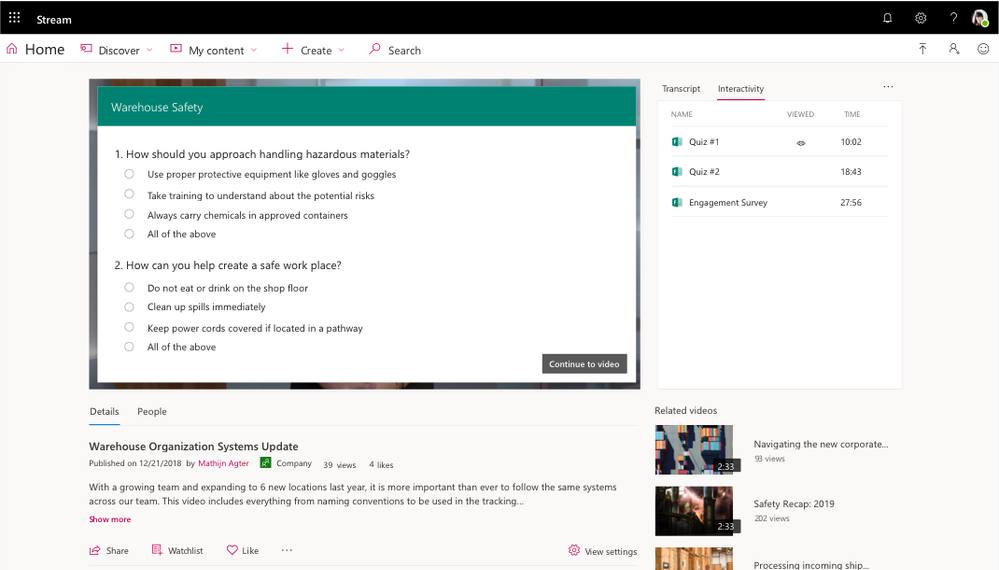
Adding quizzes and knowledge checks into your video lessons is a good way to understand how students are comprehending the material. Easily do this with Microsoft Forms and Stream by copying the Form URL and adding it into the video interactivity panel.
You can also add Stream videos into your classroom quizzes, created in Forms, allowing students to watch a short video from Stream before answering questions, or as a way to provide more background within the context of a quiz.
Use Stream video comments to measure class participation or encourage discussion about a video or topic.
Organizing videos
Having different channels and groups on Stream for your courses can help you keep your course video materials organized, and you can create them to best suit your video organization needs. If you use groups, each Stream group correlates to an Office 365 group.
For example, let’s say an 8th grade science teacher wants to share video lessons for multiple topics. He could create one group and then create a different channel for each topic in that group (Chemistry, Biology) or, he could have channels for different periods (3rd period channel, 4th period channel). After the group and channels are created, the science teacher can easily add the course-specific videos to them.
Alternatively, creating a group for each period and then adding relevant channels would provide a way to manage lessons so other class periods wouldn’t be able to watch content outside of their group.
Sharing videos
There are many ways to share your Stream video with your students. Here are three methods:
Share the video link via email, a Teams chat message, or wherever best suits your needs
Videos you create can only be watched by people (e.g., students, faculty) with licenses in your Office 365 school or tenant. You can set permissions at the video or group level to control who can access each video. Learn how to set up groups.
Viewing challenges
Sometimes, students may have challenges accessing their lessons online. Here are a few ideas that might help you navigate some of these issues.
When students have low- or no-bandwidth connectivity, live streaming may not be an option. In these situations, choosing to pre-record your videos and upload them to Stream for on-demand viewing can help to improve the playback experience for your students and make learning accessible.
Stream also can auto-generate transcripts and closed captioning for uploaded videos. This can make your video more inclusive of students who use screen readers, and more. Transcripts are also easily editable in the Stream user interface, allowing minor edits for clarity as needed.
The Stream mobile app is a handy tool if a computer is not available to your students They can sign in with their account and access the same content here as on a computer. If they don’t have a reliable data connection, they can also use the app to download and watch videos offline.
Get Office 365 Education
Students and educators at eligible institutions can sign up for Office 365 Education for free, and includes email, video conferencing, a customized hub for class teamwork with Microsoft Teams, and more.
As more in person meetings, classes, conferences and communications move to an online format, Microsoft has been listening to our customers and their needs in order to help navigate the changing remote work landscape.
Many organizations are adopting online meetings to support initiatives from distance learning with students, to day-to-day workplace activities like recurring project checkpoints that help keep employees connected and productive.
For organizations that need a way to reach many people at scale, Microsoft 365 live events enable you to deliver an immersive video broadcast to large audiences with interactive conversation, questions and answers. Live events can be hosted in Teams or Yammer, or you can create a customized event experience using Microsoft Stream.
Beginning today, to help support our customers, through June 30, 2021, events for as many as 100,000 attendees can be requested through our live events assistance program.
Teams Meetings for up to 250 participants
Live events for up to 20,000 attendees through Teams, Stream and Yammer*
Live events for up to 100,000 attendees in Stream when planned through live events assistance program
On-demand recordings for unlimited numbers of viewers so anyone who could not participate during the live event, doesn’t miss out.
We hope that these meeting and live event solutions, and increased attendee limitswill help customers address the growing need for large scale communications.
Learn more about meetings and live events and check out additional resources to help you get started.
*Additional temporary limit increase for live events. Live Events Assistance Program team is not required.

 Connexion